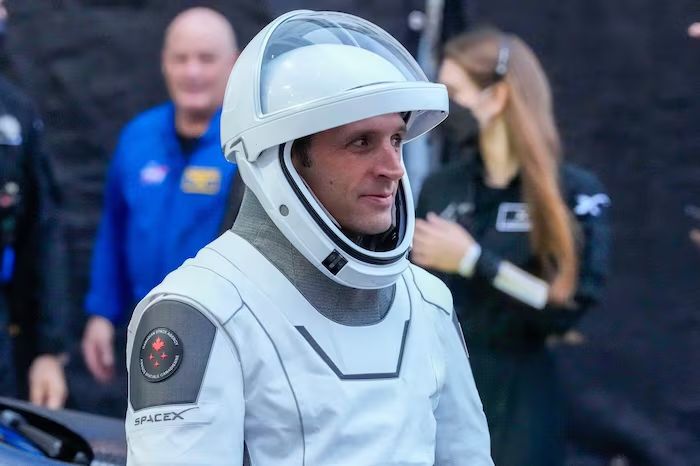
Canadian astronaut Joshua Kutryk describes 'having a blast' on first space mission
The astronaut, two weeks into a six-month stay, said he is relearning basic tasks and conducting health experiments.
LONGUEUIL — Canadian astronaut Joshua Kutryk says he is "having a blast" two weeks into his first mission aboard the International Space Station.
Kutryk held his first question-and-answer session with reporters from orbit on Tuesday, describing the challenges and wonders of life in microgravity during his six-month stay.
"It's like you're two or three years old again learning to do the most simple things in life," he said of being in space. "It can be very frustrating, but when you take a step back and look out the window and sort of laugh at yourself, it's also very fun, very satisfying."
READ MORE: Saskatchewan bison jerky selected for Canadian astronaut's space mission
READ MORE: Canadian astronaut Joshua Kutryk prepares for six-month mission to space station
He said he has had to relearn common skills, like sleeping, eating and using tools. "What do you do with your neck when you're sleeping? What do you do with your hands?" he said.
The 44-year-old from Fort Saskatchewan, Alta., launched to the station on Oct. 1 as part of a four-person NASA crew, arriving in just under eight hours in the fastest flight ever to the ISS.
He described the launch aboard a SpaceX Falcon 9 rocket as "exhilarating," "spectacular," "powerful" and "violent."
Kutryk has already begun science experiments, including several Canadian-led studies on human health in space. He noted he has lost about five pounds since arriving, illustrating the importance of exercise and nutrition.
During the briefing, he wore a sensor shirt for a Canadian experiment called AstroFit, which monitors heart rate, respiration and oxygen levels for 48 hours at a time.
"We can track changes in his physical fitness by monitoring heart rate while he does the same session on the cycle ergometer early in flight, the mid-point of the flight and again in the final few weeks of the flight," said Richard Hughson, a professor emeritus at the University of Waterloo and principal investigator for AstroFit.
Kutryk said his presence on the station is a testament to Canada's role in space exploration. "I hope people see it as testament to what Canada can do," he said.
He said it puts Canadian industry, academia and commercial entities on the leading edge of spaceflight, which is how the country innovates and develops new technologies.
He said he often sees Canada from orbit, noting during the call that the station was passing over Vancouver and would soon cross Quebec. "I do get to see the country a lot from here," he said.
He has also witnessed stunning auroras. "To see the whole Earth, the curvature of the Earth, just embraced by this blanket of dancing fluorescent oranges and yellows and pinks is magical," he said.
Kutryk brought a family heirloom to space: a pocket watch his relatives brought from Ukraine to Canada four generations ago. He said he holds it and reflects on how much has changed.
His mission follows Canadian astronaut Jeremy Hansen's lunar fly-around on the Artemis II mission six months ago. Your Space Hamilton reported in September that Kutryk's launch was delayed from an original September date.
Kutryk said he hopes Canadians see space exploration as a road to innovation and a "brighter future."
"We take a lot of benefits from these missions and it's something that that we hope we can continue Canada's strong legacy in space going forward."
With files from The Canadian Press, CBC News and The Globe and Mail