2016 Fort McMurray wildfire
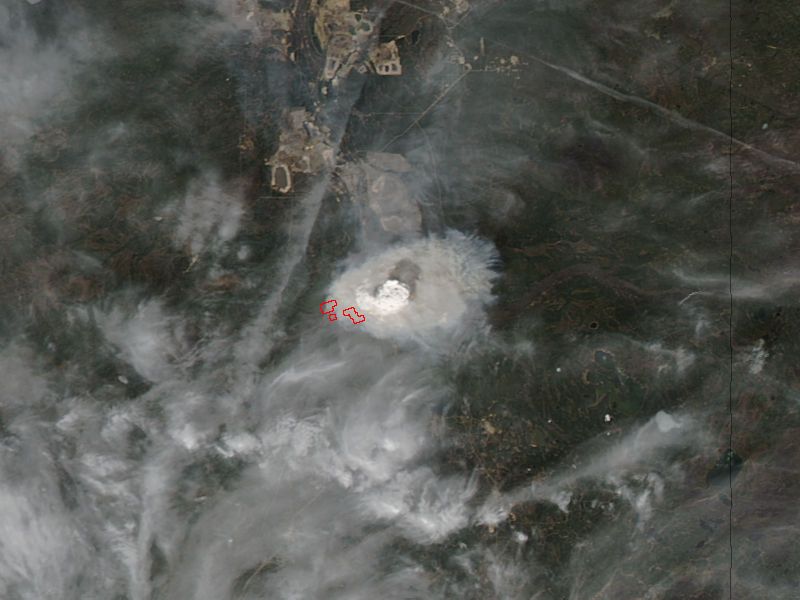
The 2016 Fort McMurray wildfire, also known as the Horse River wildfire, was a catastrophic natural disaster that began southwest of Fort McMurray, Alberta, on May 1, 2016. It forced the largest wildfire evacuation in Alberta's history, displacing approximately 88,000 residents as it swept through the community on May 3. The fire destroyed about 2,400 homes and buildings, caused an estimated C$9.9 billion in damages, and became the costliest disaster in Canadian history. It burned across nearly 590,000 hectares of forested land before being declared under control in July 2016 and fully extinguished over a year later in August 2017.
Origin and Contributing Conditions
The fire was first reported by a helicopter forestry crew on May 1, 2016, in a remote area about 15 kilometres from Fort McMurray. While an official cause has never been determined, it is suspected to have been human-caused. The fire ignited during a period of extreme weather conditions that created a perfect environment for explosive growth. An unusually hot, dry air mass had settled over northern Alberta, bringing record-setting temperatures to Fort McMurray. On May 3, the temperature climbed to 32.8 degrees Celsius with humidity as low as 12 percent, and winds gusted to 72 kilometres per hour the following day. A natural El Niño cycle had also contributed to a dry fall and winter, followed by a warm spring with a meagre snowpack that melted quickly, leaving vegetation tinder-dry. Climate change was widely discussed as a potential contributor to the intensity of the fire, with scientists and politicians noting it was part of a broader trend toward more severe wildfires, though individual events cannot be definitively linked to it.
Evacuation and Spread into the City
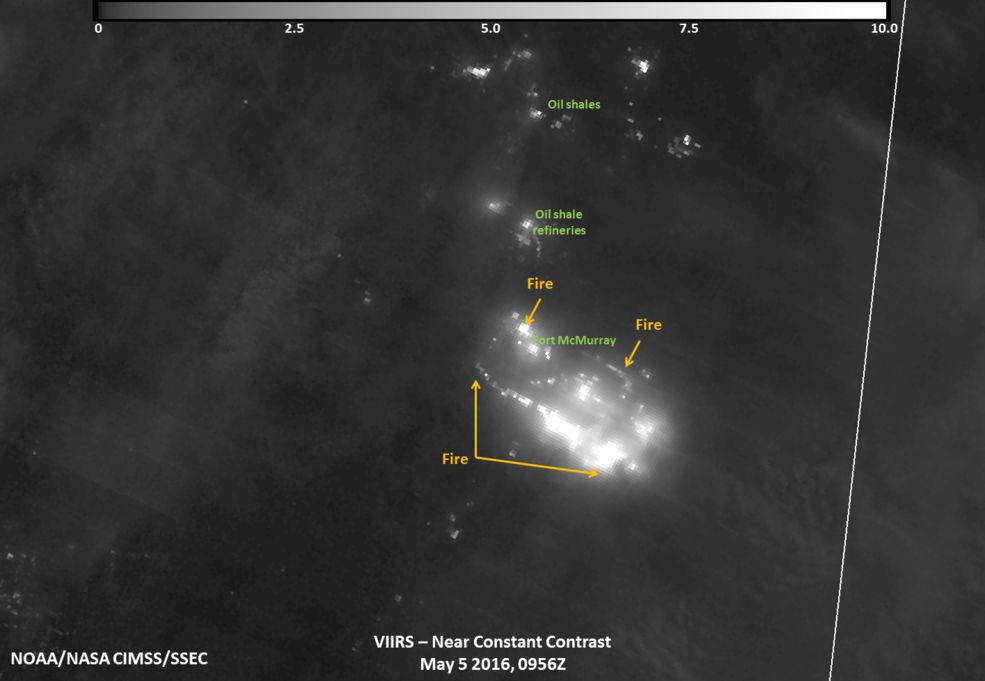
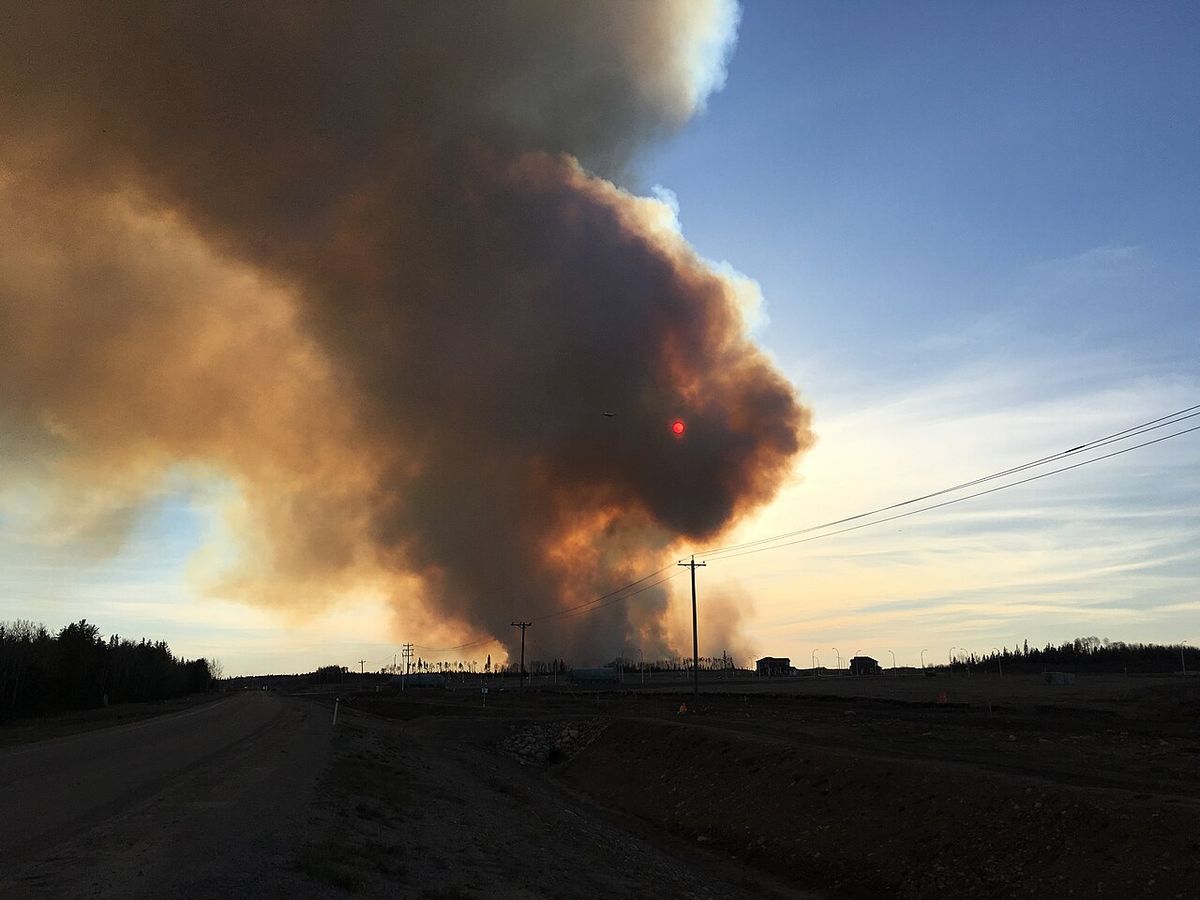
The fire's rapid advance toward Fort McMurray triggered a series of escalating evacuation orders. A local state of emergency was declared on the evening of May 1 for the Centennial Trailer Park and the neighbourhoods of Prairie Creek and Gregoire. By the afternoon of May 3, the mandatory evacuation order was expanded to 12 neighbourhoods, and by 6:49 p.m. it covered the entire city of Fort McMurray. A further order for the nearby communities of Anzac, Gregoire Lake Estates, and Fort McMurray First Nation was issued at 9:50 p.m. on May 4. The evacuation of approximately 88,000 people was executed successfully with no direct fire-related fatalities, though two people, Aaron Hodgson and Emily Ryan, died in a vehicle collision during the evacuation, and one was the daughter of a firefighter. On May 4, the fire crossed Highway 63 at Airport Road south of the city and threatened the Fort McMurray International Airport, which had suspended commercial operations. The fire grew so large and hot that it began generating its own weather, including pyrocumulus clouds and lightning, which increased the risk of new ignitions. Key events during the critical first week included the fire's spread to 100,000 hectares by May 6 and 200,000 hectares by May 7, forcing the evacuation notice for the community of Fort McKay which was itself hosting 5,000 evacuees.
- May 1: Fire reported. Local state of emergency declared.
- May 3: Entire city of Fort McMurray under mandatory evacuation order.
- May 4: Provincial state of emergency declared. Fire crosses Highway 63. Communities of Abasand, Waterways and one other suffer serious loss.
- May 5-6: Fire grows to 100,000 hectares. RCMP leads convoys to move 1,500 vehicles from northern work camps south to Edmonton.
- May 7: Fire reaches 200,000 hectares in size.
Remote Growth and Final Containment
After devastating the urban area, the wildfire continued to spread uncontrollably through remote boreal forest and towards major oil sands operations to the north. It forced the evacuation of 19 oil sands work camps, displacing about 8,000 workers and destroying the 665-unit Blacksands Executive Lodge on May 16. The fire crossed into Saskatchewan, eventually burning 741 hectares in that province. Firefighting efforts involved a massive deployment of resources, including 1,110 personnel, 145 helicopters, 138 pieces of heavy equipment, and 22 air tankers at the peak. The arrival of rain and cooler temperatures in mid-June finally helped crews contain the blaze. The fire was officially declared under control on July 5, 2016. However, it continued to smoulder underground in peat and organic soil throughout the following winter. Provincial officials conducted thermal surveys and, after detecting no remaining hot spots, officially declared the wildfire fully extinguished on August 2, 2017. The fire had grown from 285,000 hectares on May 16 to over half a million hectares in just five days during its most aggressive remote spread.
Emergency Response and Aid
The response to the disaster involved all levels of government, the military, and international support. The Government of Alberta declared a provincial state of emergency on May 4 and formally requested assistance from the Canadian Armed Forces, which provided helicopters and a CC-130 Hercules aircraft for logistics after a memorandum of understanding was signed with the Department of National Defence. The Royal Canadian Mounted Police deployed approximately 300 officers to provide security. Through the Canadian Interagency Forest Fire Centre, other provinces sent firefighters, including 100 from Ontario along with 19 supervisory staff, and Quebec dispatched four CL-415 water bombers. South Africa sent 301 firefighters in late May at the request of the CIFFC, though a wage dispute led to a brief strike that was resolved after Premier Rachel Notley intervened to ensure they were paid at least C$11.20 per hour as per Alberta law, rather than the C$15 per day in their original contract. Financial aid was swiftly organized. The Alberta government provided direct payments of $1,250 per adult and $500 per dependent to evacuees. Both the provincial and federal governments pledged to match public donations to the Canadian Red Cross, with the province adding a $2 million seed donation. By May 9, public donations alone had reached $54 million. Public Safety Canada also activated the International Charter Space and Major Disasters to provide satellite imagery from 15 space agencies for response coordination. Local and national organizations also provided support, such as the partnership between Edmonton's Capital Region Housing Corporation, the City of Edmonton, and others to create a free rental registry for evacuees. Prime Minister Justin Trudeau visited Fort McMurray on May 13 to survey the damage and promise ongoing federal aid, while Governor General David Johnston and Sophie, Countess of Wessex, visited on June 24, 2016, meeting with first responders and touring the damaged areas. The Alberta government also announced a plan on May 5 to airlift approximately 8,000 of the 25,000 people who had evacuated to northern oil sands camps, using RCAF and energy company aircraft.
Economic and Industrial Impact
The wildfire caused a massive disruption to Canada's energy sector, as it swept near and through major oil sands production facilities north of Fort McMurray. Companies including Shell Canada, Suncor Energy, and Syncrude Canada were forced to scale back or completely shut down operations to evacuate workers and accommodate fleeing residents in their work camps. Shell shut its Albian Sands operation 70 kilometres north of the city, using its airstrip to fly employees out and providing two firefighting teams. Suncor scaled back operations at its Millennium and North Steepbank mines, while Syncrude shut down all site processing at its Mildred Lake facility on May 7, removing 4,800 employees. At its peak in May 2016, the fire halted approximately one million barrels of oil per day, equivalent to a quarter of Canada's total oil production. The following table illustrates the scale of the production impact and economic cost.
| Metric | Impact |
|---|---|
| Peak daily production halted | 1 million barrels |
| Production halted in June 2016 | 700,000 barrels per day |
| Estimated daily cost to Alberta's economy | $70 million |
| Contribution to global oil prices | Contributing factor to price rises |
| Gasoline shortages | Reported throughout Western Canada |
The scaled-back operations, combined with a refinery outage in Edmonton, led to gasoline shortages at stations across Western Canada. The insurance industry faced unprecedented claims, with initial estimates suggesting total rebuild costs could reach C$9 billion. By July 7, 2016, insured damage was estimated at C$3.58 billion by the Insurance Bureau of Canada, making it the costliest insured disaster in Canadian history, surpassing the 1998 ice storm and the 2013 Alberta floods. A later estimate projected insurance payouts could reach as high as C$4.7 billion. The lost output was estimated to cost the Albertan economy $70 million per day during the peak of the disruption.
Community Recovery and Infrastructure
The recovery process for Fort McMurray was lengthy and complex, affecting housing, utilities, and essential services. In the immediate aftermath, the entire region was under a boil-water advisory until August 17, 2016, because untreated water had been pumped into the municipal system for firefighting. The most damaged neighbourhoods, Waterways, Abasand, and the one heavily affected, were declared unsafe for reoccupation due to contamination from arsenic and heavy metals in the debris. Residents were not allowed to return until the end of October 2016. Overnight on May 16 and 17, two explosions in the Thickwood and Dickensfield neighbourhoods damaged 10 buildings and destroyed three. The town's power grid sustained significant damage, and the Regional Emergency Operations Centre had to be relocated from near the airport due to the fire's threat. Statistics Canada had to suspend its 2016 census enumeration in the area on May 5 and later used alternative methods like Canada Revenue Agency tax records, local vital statistics, and early online submissions to compile an accurate community profile. Approximately 2,000 residents from the three most contaminated neighbourhoods were displaced long-term after their homes were declared unsafe, and about 85 to 90 percent of the community was ultimately reported as undamaged.
Environmental and Historical Context
The 2016 Fort McMurray wildfire had significant environmental consequences that extended beyond the immediate burn area. The fire burned through approximately 590,000 hectares of land, an area comparable in size to Prince Edward Island, consuming vast tracts of boreal forest. Air quality was severely degraded across the region during the active burning period, and the fire became large enough to create a firestorm with its own weather patterns. The event was later detailed in author John Vaillant's best-selling book, Fire Weather: On the Front Lines of a Burning World, which examined the fire within the context of global warming. Historically, the fire far surpassed the scale and cost of previous Canadian wildfire disasters, notably the 2011 Slave Lake wildfire which destroyed one-third of that town and cost approximately $750 million. The Fort McMurray fire's damage estimates were an order of magnitude larger, partly due to Fort McMurray being roughly ten times the size of Slave Lake. The fire's duration, from its ignition through to its final extinguishment, spanned more than 15 months, highlighting the persistent threat of deep-seated ground fires in northern forest ecosystems.
Political Context and Controversies
The disaster occurred amidst political debates over resource allocation and response. The Alberta government faced criticism for cutting $15 million from the province's wildfire suppression budget in April 2016, just weeks before the fire began. Premier Rachel Notley argued that emergency funds were unlimited for fighting fires, but local air tanker companies contended the cuts created staffing challenges and would make it harder to keep personnel on duty. Cuts were also made to fire preparation budgets for activities like creating fire breaks, though it was uncertain if such measures would have been effective against a fire powerful enough to cross the Athabasca River. The federal government, led by Prime Minister Justin Trudeau, was criticized for declining offers of international firefighting assistance from countries including Russia, the United States, Australia, Israel, Mexico, the Palestinian Authority, and Taiwan. Russia had specifically offered Ilyushin Il-76 aircraft capable of carrying 42 tons of fire suppressant. Trudeau stated that while the offers were appreciated, they were unnecessary as Canadian resources were gaining control. He was also criticized on May 6 for not yet visiting the area, to which he responded that showing up while firefighters were busy could be unhelpful, drawing comparisons to a previous prime minister's visit to a British Columbia fire zone. Trudeau ultimately visited Fort McMurray on May 13, 2016.
Questions about 2016 Fort McMurray wildfire
How many people were evacuated during the Fort McMurray wildfire?
Approximately 88,000 residents were forced to evacuate their homes, making it the largest wildfire evacuation in Alberta's history. The evacuations were carried out in stages, beginning with specific neighbourhoods on May 1 and expanding to the entire city by the evening of May 3, with further orders for outlying communities on May 4. Despite the scale and speed of the evacuation, there were no direct fatalities from the fire itself, though two people died in a vehicle collision during the evacuation process. Evacuees who travelled north were advised to stay in place and not travel south on Highway 63 while the fire was active.
What was the total cost of the Fort McMurray wildfire?
The total estimated damage from the wildfire is C$9.9 billion. In terms of insured losses, the disaster set a Canadian record, with estimates reaching C$3.58 billion by July 2016, surpassing previous disasters like the 1998 ice storm and the 2013 Alberta floods. The cost includes the destruction of approximately 2,400 homes and buildings, massive disruption to the oil sands industry, and extensive environmental rehabilitation efforts across nearly 590,000 hectares of burned forest. A further estimate suggested insured payouts could climb to C$4.7 billion, and the 2011 Slave Lake wildfire cost approximately $750 million for comparison.
How did the wildfire affect Canada's oil production?
The wildfire caused a major shutdown in the Athabasca oil sands region, halting about one million barrels of oil per day at its peak in May 2016, which was roughly a quarter of Canada's total production. Companies like Shell, Suncor, and Syncrude scaled back or stopped operations to evacuate workers and use their camps to house evacuees. The disruption continued into June at a rate of 700,000 barrels per day, costing the Alberta economy an estimated $70 million daily and contributing to a rise in global oil prices. The shutdown also contributed to gasoline shortages in Western Canada, and oil companies anticipated financial impacts would wear off by the end of the third fiscal quarter.
What kind of aid did the evacuees receive?
Evacuees received immediate financial assistance from the Alberta government, which provided $1,250 per adult and $500 per dependent to cover living expenses. The Canadian Red Cross launched a major fundraising campaign, with donations matched by both the provincial and federal governments, raising $54 million in public donations alone by May 9. Other aid included the creation of a free rental registry for evacuees in Edmonton, and many oil sands companies opened their work camps to house displaced residents. The Canadian Armed Forces, RCMP, and firefighters from other provinces and South Africa provided critical operational support, and some landlords offered reduced rents or deposits to evacuees.
When was the Fort McMurray wildfire finally put out?
The Fort McMurray wildfire was declared under control on July 5, 2016, but it continued to smoulder. It was fully extinguished on August 2, 2017, after provincial officials conducted thermal surveys and detected no further hot spots. The fire had spread across approximately 590,000 hectares before being brought under control. It continued to burn in deeper layers of moss and dirt throughout the winter following its containment. The fire's long duration and eventual extinguishment marked the end of a disaster that lasted over 15 months.
What were the main contributing factors to the fire's severity?
The fire's rapid growth was driven by a 'perfect storm' of extreme weather conditions and environmental factors. An unusually hot, dry air mass brought record setting temperatures to Fort McMurray, reaching 32.8 degrees Celsius with humidity as low as 12 percent. Strong winds gusting to 72 km/h further fueled the blaze. A natural El Niño cycle contributed to a dry fall and winter, leaving a paltry snowpack that melted quickly. The fire's own heat and size led it to produce lightning and pyrocumulus clouds, creating its own weather. While the official cause is undetermined, it was suspected to be human caused, and the event prompted debate about climate change as a potential contributor to more intense wildfires.
Sources and further reading
- 2016 Fort McMurray wildfire (Wikipedia)
- Recap of The Fort McMurray Wildfire (accomsure.com)
- Alberta Fires Response 2016 - Canadian Red Cross (redcross.ca)
- Forged by fire: Fort McMurray 5 years after the disaster (newsinteractives.cbc.ca)
Checked by the Your Space Hamilton desk. Last updated 2026-10-22.