Snowmobile
A snowmobile is a motorized vehicle designed for winter travel and recreation on snow, featuring a continuous track at the rear for propulsion and front skis for steering. Its development, particularly in Canada, was driven by the need for reliable transportation in deep snow, leading to innovations by pioneers like Joseph-Armand Bombardier. The snowmobile evolved from a utilitarian workhorse into a major platform for winter recreation and sport, with a significant cultural and economic footprint across Canada's northern and rural regions. As of 2026, the market is shared between three large North American manufacturers and some specialized makers, while the industry continues to innovate with electric models and specialized designs.
Early origins and mechanical predecessors
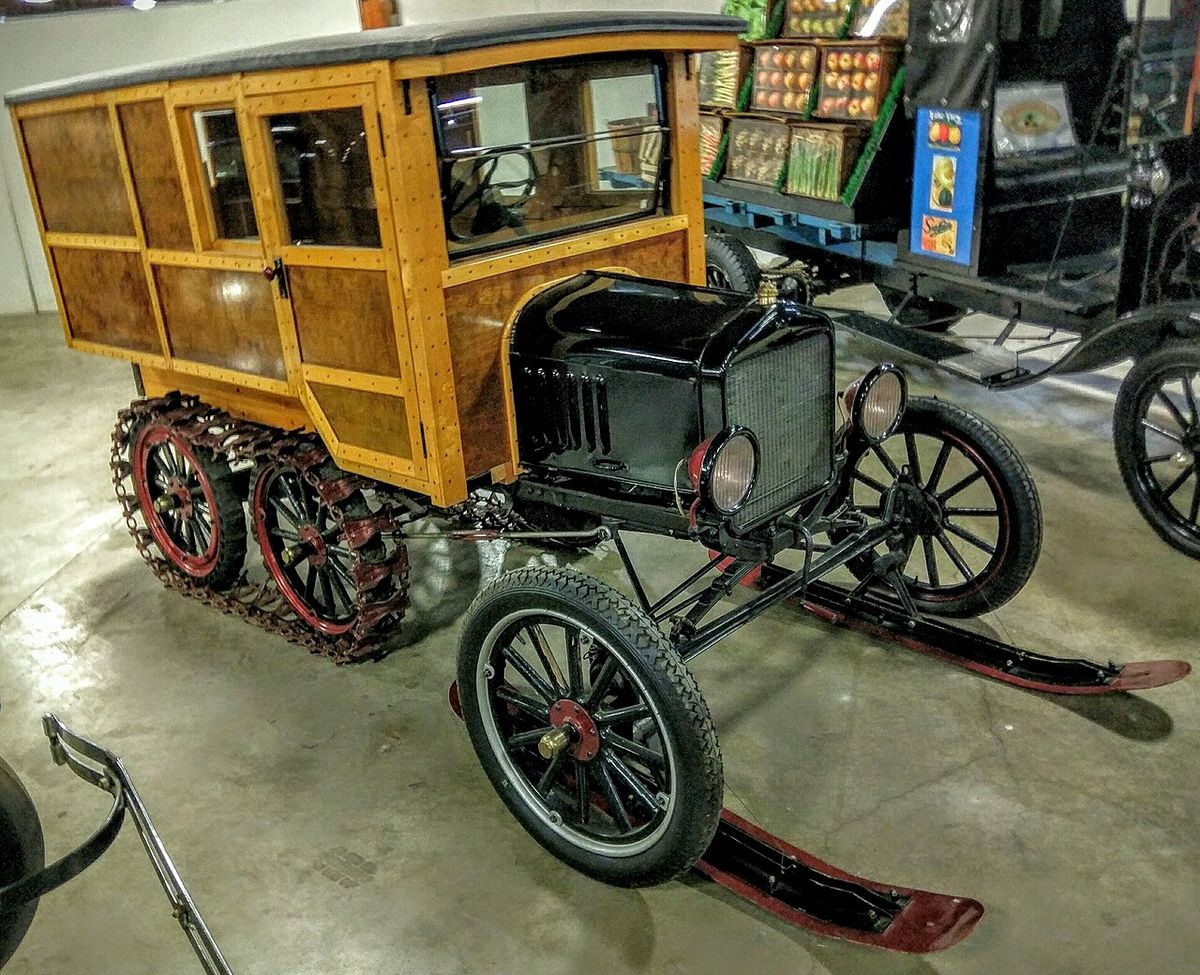
The quest for winter mobility led to numerous early experiments with motorized sleds. In 1895, William J. Culman and William B. Follis of Brule, Wisconsin, submitted a patent for a Sled-Propeller design, though no model was built. The early 20th century saw various prototypes, including the short-lived American Motor Sleigh produced in Boston from 1905 to 1906, and Igor Sikorsky's propeller-driven Aerosledge built in Russia around 1909. A significant mechanical ancestor was the Kégresse track, a flexible caterpillar system invented by Adolphe Kégresse while working for Tsar Nicholas II of Russia between 1906 and 1916, which converted cars like Rolls-Royces and Packard trucks into half-tracks. The first United States patent for a vehicle using the now-standard format of rear tracks and front skis was granted to Ray H. Muscott of Michigan on June 27, 1916, for his motor sleigh. Many individuals subsequently created 'Snowflyers' by converting Ford Model Ts with tracks and skis, which saw use in rural mail delivery. In 1914, O. M. Erickson and Art Olsen built an open two-seater 'motor-bob' from a modified Indian motorcycle, which had a similar appearance to later snowmobiles but lacked tracks.
The invention of the modern snowmobile
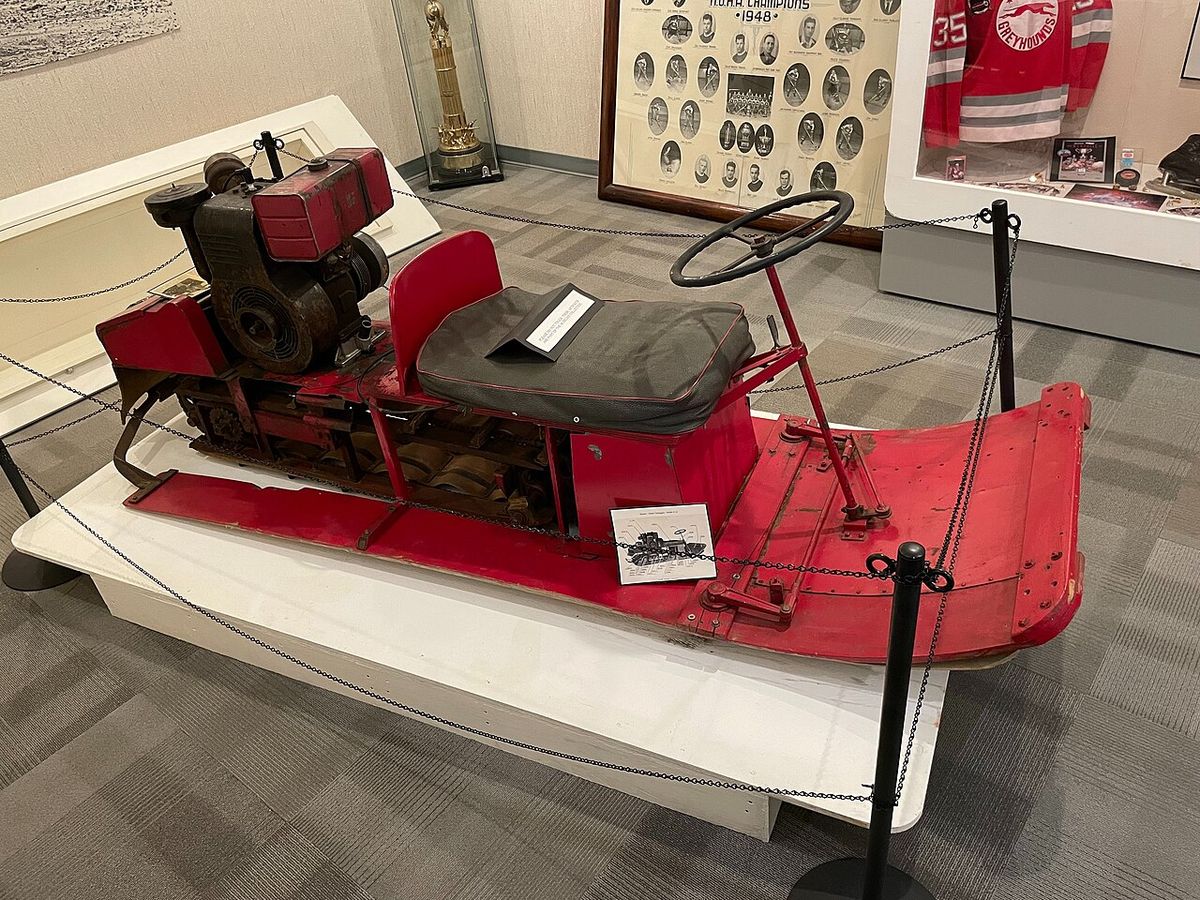
The direct prototype of the modern snowmobile is credited to Carl Eliason of Sayner, Wisconsin, who developed the Eliason Motor Toboggan in 1924. His design mounted a two-cylinder motorcycle engine on a toboggan, using front skis for steering and a single, endless track for propulsion. Eliason patented his invention in 1927, made about 40 machines, and later sold the patent to the FWD Company, which produced 300 for military use before transferring it to a Canadian subsidiary that produced models through 1963. In Canada, Joseph-Armand Bombardier of Valcourt, Quebec, addressed the limitations of converted vehicles in the humid snow of Quebec and New England. After years of experimentation with metal tracked vehicles since 1928, he invented a new rubber-and-cotton track traction system featuring a toothed wheel covered in rubber. This led to the production of his enclosed, multi-passenger snowmobiles, starting with the seven-passenger B-7 in 1937, which used a Ford V-8 flathead engine. He introduced the twelve-passenger B-12 in 1942, powered by a Chrysler industrial flathead six-cylinder engine, with 2,817 units produced until 1951. These vehicles served as ambulances, Canada Post vehicles, winter school buses, forestry machines, and army vehicles in World War II, fulfilling Bombardier's initial vision for practical winter transport.
Post-war commercialization and market evolution
The post-war era shifted the snowmobile from a utility vehicle to a mass-market recreational product. In 1955, Edgar and Allen Hetteen and David Johnson of Roseau, Minnesota, developed a lighter, more agile machine, leading their company, Hetteen Hoist & Derrick Co., later named Polaris Industries, to introduce the first commercial model, the Polaris Sno Traveler, in 1957. Joseph-Armand Bombardier followed in 1960 by launching the open-cockpit, one or two-person Ski-Doo through his company Bombardier Inc., which ignited widespread consumer interest. The 1970s saw a boom with over a hundred manufacturers, and from 1970 to 1973 two million machines were sold, peaking at 500,000 units in 1971. Many small companies failed during the 1973 oil crisis and succeeding recessions, consolidating the industry. Sales later rebounded to 260,000 in 1997 but gradually decreased afterward, influenced by warmer winters and the use of small all-terrain vehicles. Major brands that emerged and endured include Arctic Cat, founded by snowmobile pioneer Edgar Hetteen in 1960, and Yamaha, which produced snowmobiles from 1968 until ending production in 2025. Other notable historical manufacturers included Scorpion, which started as Trail-A-Sled in 1959, Moto-Ski from 1963, John Deere from 1972, and the Swedish makers of the Larven and Ockelbo.
Technical design and performance characteristics
Modern snowmobiles are powered by two-stroke or four-stroke internal combustion engines, with electric models like the Taiga TS2 entering the market. Historically, two-stroke engines were favoured for their reduced complexity, weight and cost, but four-stroke engines have gained popularity since becoming more readily available on new models around 2003. Yamaha exclusively produced four-stroke snowmobiles during its production run. Engine power has increased dramatically from early models with around 5 horsepower to contemporary machines with displacements up to 1,200 cc producing over 150 horsepower, with some turbocharged models exceeding 210 horsepower. Tracks have evolved from simple rubber to advanced Kevlar composite constructions for durability and grip. Most modern snowmobiles are single-rider designs, with two-person 'touring' or '2-up' models representing an extremely small share of the market. Most snowmobiles have no enclosures except for a windshield. Performance varies significantly by model type and intended use, with specialized designs for different terrains and activities.
Key design variations cater to different uses. Snowmobiles designed for deep snow, known as mountain sleds, differ from trail sleds in their weight, weight distribution, track length, paddle depth, and power. Trail snowmobiles, including heavy 'muscle sleds', are built for speed on groomed trails and can produce speeds in excess of 100 mph. Sno-cross oriented snowmobiles often have an engine size cap. Work task snowmobiles with dual tracks are also manufactured for carrying supplies and pulling loads.
- Mountain sleds: Designed for deep snow boondocking with longer tracks, deeper paddles, optimized weight distribution, and engine sizes typically around 800 cc producing 150 hp.
- Trail sleds: Built for speed on groomed trails, often with powerful engines up to 1,200 cc, short tracks, and good traction, capable of speeds over 100 mph.
- Snocross sleds: Built for racing on motocross-like courses, often with an engine size cap of 440 or 600 cc.
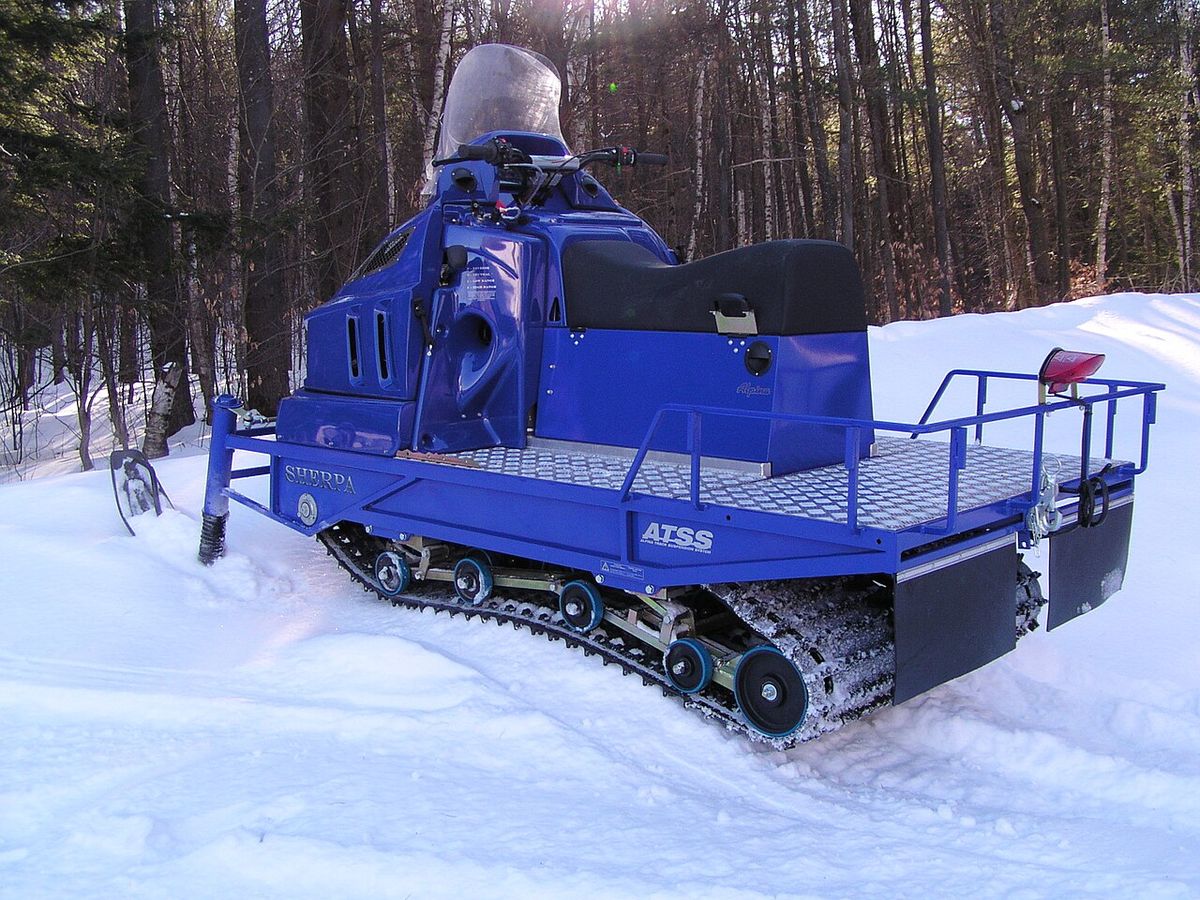
- Utility sleds: Include dual-track models like the Alpina Sherpa, built for hauling cargo, pulling sleds, and trail grooming with low top speeds.
- Drag racing sleds: Heavily modified for straight-line speed, capable of exceeding 200 mph.
Riding techniques like side-hilling allow snowmobiles to traverse steep hillsides without sliding down-slope. Riders often perform aerial maneuvers off cornices and other kinds of jumps. They also search for non-tracked, virgin terrain to trailblaze or boondock. The introduction of the REV chassis platform by Ski-Doo in 2003 marked a significant advance in mountain snowmobile design and handling. Higher-powered modern snowmobiles can achieve speeds over 150 mph. Drag racing snowmobiles can reach speeds over 200 mph.
Major manufacturers and market landscape
As of 2026, the snowmobile market is shared primarily between three large North American manufacturers and several specialized makers. Bombardier Recreational Products, headquartered in Quebec, produces the Ski-Doo brand and the Lynx brand, which it acquired in 1988 after Lynx was produced in Finland by Velsa Oy and later Nordtrac. Polaris Industries and Arctic Cat, both based in Minnesota, are the other dominant players. Specialized manufacturers include Quebec based AD Boivin, maker of the Snow Hawk, and the Italian company Alpina s.r.l., which has produced dual-track work snowmobiles since 1995, including the Sherpa and Superclass models. Yamaha ended its snowmobile production in 2025. The market is primarily recreational, with annual sales historically exceeding 90,000 units in North America, though sales figures have fluctuated. The vast majority of snowmobiles are sold in regions with stable winter snow cover, with a very small market in Arctic territories despite their utility there. Several manufacturers have historically produced dual-track work machines, including Sweden's Aktiv and Ockelbo, and Russia's Buran.
| Manufacturer | Key Brands/Models | Origin/Status | Notable Fact |
|---|---|---|---|
| Bombardier Recreational Products | Ski-Doo, Lynx | Quebec, Canada | Market leader, launched Ski-Doo in 1960 |
| Polaris Industries | Polaris | Roseau, Minnesota, USA | Introduced first commercial model, Sno Traveler (1957) |
| Arctic Cat | Arctic Cat | Founded in Minnesota, USA | Founded by Edgar Hetteen in 1960 |
| Alpina s.r.l. | Sherpa, Superclass | Vicenza, Italy | Maker of dual-track utility sleds since 1995 |
| Taiga Motors | Taiga TS2 | Montreal, Quebec, Canada | Producer of first commercial electric snowmobile |
| AD Boivin | Snow Hawk | Quebec, Canada | Specialized manufacturer |
Recreational uses and competitive sports
Snowmobiling has grown into a major winter pastime with numerous organized sports and informal activities. Trail riding on extensive groomed networks is the most common recreational activity, often involving large groups. Competitive racing includes several distinct, well-established disciplines with major annual events. Snocross involves racing on motocross style courses with jumps and tight turns, with series held across northern North America, such as the Northeast SnoX Challenge in Malone, New York, run by Rock Maple Racing. Ice racing takes place on oval tracks, with premier events like the World Championship Snowmobile Derby held each winter in Eagle River, Wisconsin. Drag racing occurs on snow, grass, or asphalt, with the largest event being Hay Days in North Branch, Minnesota, on the first weekend after Labour Day. Long distance endurance races test reliability, most notably Alaska's Iron Dog, which covers 2,031 miles from Big Lake to Nome to Fairbanks. Hill climb competitions, such as the World Championship Hill Climb at Snow King Mountain in Jackson, Wyoming each March, challenge riders to ascend steep slopes. Snowmobile skipping, where machines are raced across water on a marked course, is a specialized summer event held in July in Grantsburg, Wisconsin. Vintage snowmobile racing has also grown in popularity as a sporting event on the Canadian prairie and in the United States.
Major racing events include the International 500, a large 500-mile race held annually in Sault Sainte Marie, Michigan. Another major event is Hay Days in North Branch, Minnesota, which is the largest drag racing event. Recreational snowmobiling includes activities known as snowcross or racing, trail riding, freestyle, boondocking, ditchbanging, and grass drags. In summertime, snowmobilers can drag race on grass, asphalt strips, or even across water.
- International 500: A 500-mile race on a track in Sault Sainte Marie, Michigan, held since February 1969 with a purse over $40,000.
- World Championship Snowmobile Derby: Ice oval racing in Eagle River, Wisconsin.
- World Championship Watercross: Snowmobile skipping in Grantsburg, Wisconsin.
- World Championship Hill Climb: In Jackson, Wyoming, a four-day event drawing around 10,000 attendees.
- Iron Dog: The world's longest snowmachine race in Alaska.
Variants and specialized adaptations
Beyond traditional snowmobiles, several vehicle variants have been developed for specific purposes and user preferences. The snow bike replaces a motorcycle's rear wheel with a single track and the front wheel with a ski, creating a highly agile machine for deep snow with a tight turning radius. Companies like Timbersled, which was acquired by Polaris in 2015, produced conversion kits and dedicated snow bike systems until 2025. The first prototypes of motorcycles with a rear tread date to the 1920s, but modern kits for post-1990s motorcycles brought them to market. Snow bikes were introduced into elite competition at the Winter X Games XXI in 2017 with a SnowBikeCross race. For heavy duty work, dual-track snowmobiles like the Alpina Sherpa and Superclass provide a large footprint with twin 20 by 156 inch tracks and dual skis to float on top of deep snow. The Sherpa uses a 1.6L four-cylinder automotive engine, while the newer Superclass uses a 1.2L three-cylinder engine, both designed for pulling cargo sleds, carrying passengers, and trail grooming with top speeds below 52 mph. Another historical variant was the Swedish Larven, a very small and basic design produced by the Lenko Company of Östersund from the 1960s to the 1980s where the driver sat on the engine and steered using skis on their feet.
Cultural significance and environmental considerations
In Canada, the snowmobile is a cultural icon integral to winter life in many communities, particularly in rural and northern regions. It provides critical winter transportation in remote areas, supports tourism industries through extensive trail networks, rental operations, and destination resorts, and is a central activity for family and social recreation. The machine enabled the development of vast, interconnected trail systems maintained by volunteer clubs across the country, creating a unique winter infrastructure. Riders, known as snowmobilers, sledders, or slednecks, engage in activities like trail riding, freestyle, boondocking, ditchbanging, and grass drags. In the summertime, snowmobilers can drag race on grass, asphalt strips, or even across water in snowmobile skipping events. Environmentally, the industry has faced challenges related to emissions from traditional two-stroke engines and noise pollution in natural areas. This has driven significant innovation, including the shift toward cleaner four-stroke engines and the development of fully electric models like the Taiga TS2, which weighs 470 lb and offers 250 Nm of instant torque. Electric models are being tested in sensitive areas such as the Whistler Blackcomb ski resort for their lower noise output. Manufacturers continue to work on improving fuel efficiency, emissions control, and reducing the auditory footprint of snowmobiles to ensure sustainable access to winter landscapes and address environmental concerns.
Questions about Snowmobile
Who invented the snowmobile?
The modern snowmobile's invention is attributed to multiple pioneers. Carl Eliason of Wisconsin built the prototype Eliason Motor Toboggan in 1924, which used the now standard format of a rear track and front skis. In Canada, Joseph-Armand Bombardier is credited with inventing a revolutionary rubber and cotton track system in the 1930s, leading to his enclosed multi passenger snowmobiles. The first commercial model for recreational use was the Polaris Sno Traveler, introduced in 1957 by Polaris Industries, whose founders developed their design in 1955.
What is the difference between a snowmobile and a Ski-Doo?
Snowmobile is the generic term for the vehicle. Ski Doo is a specific brand name owned by Bombardier Recreational Products, launched by Joseph Armand Bombardier in 1960. The name Ski Doo became so popular in parts of Ontario and Quebec that it was often used as a generic, dated eponym for all snowmobiles. However, Ski Doo represents one line of models among competitors like Arctic Cat, Polaris, and others.
How fast can a snowmobile go?
Speed varies greatly by model and purpose. Modern high performance trail snowmobiles can achieve speeds over 150 mph (240 km/h). Specially modified drag racing snowmobiles can exceed 200 mph (320 km/h). In contrast, utility focused models like the Alpina Sherpa are designed for pulling power, with top speeds kept below 52 mph (84 km/h). Most recreational trail riding occurs at lower, safer speeds appropriate for conditions and trail design.
Are there electric snowmobiles?
Yes, electric snowmobiles are a growing segment of the market. Taiga Motors, based in Montreal, created the first commercially produced electric snowmobile, the Taiga TS2. It offers instant torque, can accelerate from zero to 100 km/h in about three seconds, and produces lower noise compared to gasoline models. Electric models are being tested in environmentally sensitive areas like ski resorts, signalling a shift toward cleaner winter recreation technology.
What is the longest snowmobile race?
The longest snowmobile race in the world is Alaska's Iron Dog. It covers a distance of 2,031 miles (3,269 km) from Big Lake to Nome and then on to Fairbanks. The event's name references the popular Alaskan tradition of dog mushing. This race is a major test of endurance for both the snowmobiles and the two person teams that compete across the challenging Arctic landscape.
What happened to Yamaha snowmobiles?
Yamaha ended its snowmobile production in 2025. The company had been manufacturing snowmobiles since 1968 and was notable for producing only models with four stroke engines. Following its exit, the snowmobile market is shared between three large North American makers: Bombardier Recreational Products (which makes Ski Doo and Lynx), Arctic Cat, and Polaris. Some specialized manufacturers, such as AD Boivin and Alpina, also operate in the market.
Sources and further reading
- Snowmobile (Wikipedia)
- Snowmobiling (greenstone.ca)
- Landmark snowmobile season across Ontario (toronto.citynews.ca)
- The most beautiful snowmobile trails in Québec (bonjourquebec.com)
- Snowmobiling (panoramaresort.com)
Checked by the Your Space Hamilton desk. Last updated 2026-10-22.