Don Page
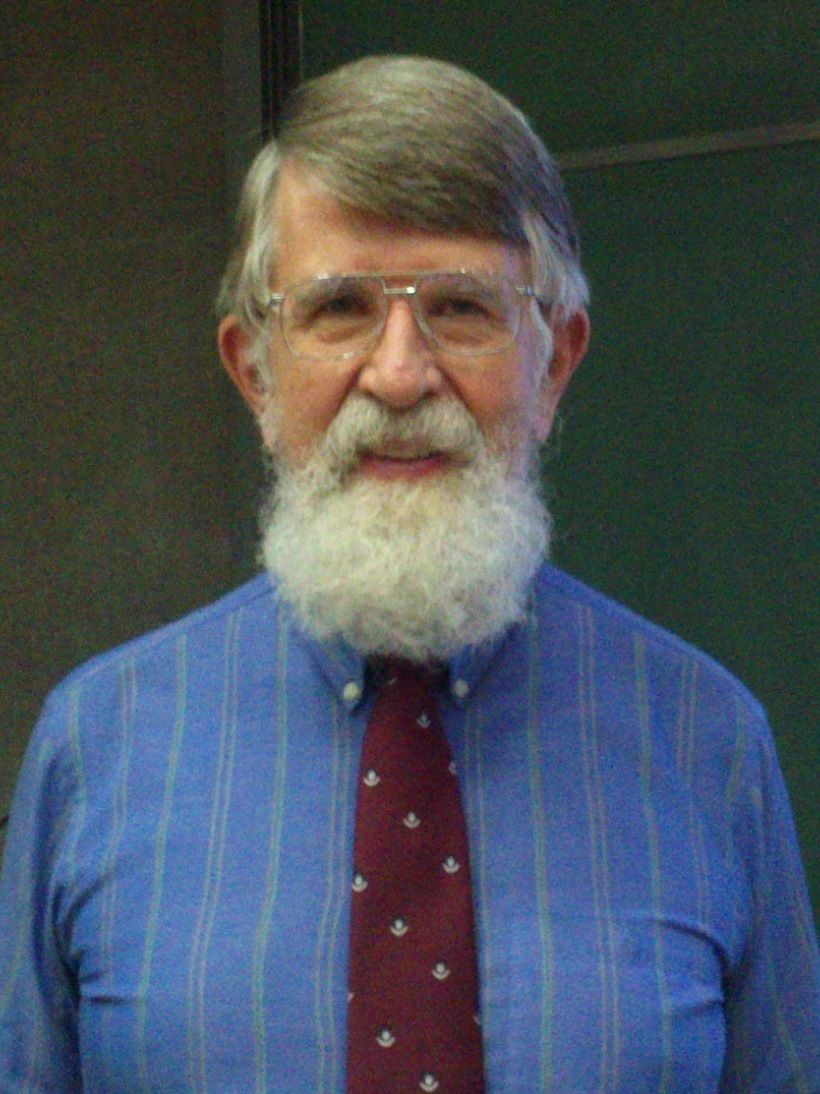
Don Nelson Page (born December 31, 1948) is an American-born Canadian theoretical physicist and professor at the University of Alberta. A former doctoral student of Stephen Hawking, Page is a leading figure in quantum cosmology and gravitational physics, known for his work on the black hole information paradox and the concept of the Page curve. His research has significantly shaped modern understanding of black hole thermodynamics and quantum gravity. Page is also notable as an Evangelical Christian who has publicly engaged in dialogues about science and religion. He was elected a Fellow of the Royal Society of Canada in 2012.
Early life and education
Don Page was born on December 31, 1948, in the United States. He completed his undergraduate education at William Jewell College in Liberty, Missouri, earning a Bachelor of Arts degree in 1971. He then pursued graduate studies in physics at the prestigious California Institute of Technology (Caltech). Page obtained his Master of Science degree from Caltech in 1972, followed by his Doctor of Philosophy in 1976. His doctoral research was supervised by the renowned theoretical physicist Stephen Hawking, who was a visiting professor at Caltech during the 1974 to 1975 academic year. This mentorship established a foundational professional relationship that influenced Page's career trajectory and research focus for decades to come.
Academic career
Don Page began his professional academic career immediately after completing his PhD. From 1976 to 1979, he served as a research assistant at the University of Cambridge, continuing his work in the field of theoretical cosmology. In 1979, he returned to North America to join the faculty of Pennsylvania State University as an assistant professor. He was promoted to associate professor and then to full professor in 1986, a position he held for four more years. In 1990, Page moved to Canada to accept a professorship in the Department of Physics at the University of Alberta in Edmonton, where he has remained a prominent member of the faculty. His career is characterized by a long tenure at a single Canadian institution, contributing significantly to its research profile in theoretical physics.
Scientific contributions and the Page curve
Page's research is centred on quantum cosmology and theoretical gravitational physics, with a particular focus on black holes. His most famous contribution, formulated in 1993, addresses the black hole information paradox, a fundamental problem concerning whether information is lost when matter falls into a black hole. Page argued that if a black hole begins in a pure quantum state and evaporates completely via a unitary process, the von Neumann entropy of the emitted Hawking radiation follows a specific pattern. The entropy initially increases as the black hole radiates but then decreases back to zero once the black hole has fully evaporated, preserving information. This predicted behaviour of entropy over time is known as the Page curve.
The point at which the entropy curve reaches its maximum and begins to decrease is called the Page time. For many physicists, successfully deriving the Page curve from first principles is considered equivalent to solving the black hole information paradox. Page's work provided a crucial quantitative benchmark for testing proposals in quantum gravity, such as the AdS/CFT correspondence and recent developments in holography. His insights have guided decades of subsequent research, making the Page curve a central concept in modern theoretical physics.
Awards and recognition
In recognition of his distinguished contributions to science, Don Page was elected a Fellow of the Royal Society of Canada in 2012. This honour is one of the highest academic accolades in Canada, awarded to individuals who have made remarkable achievements in the arts, humanities, and sciences. His fellowship acknowledges his influential work on quantum gravity and cosmology, which has had a lasting impact on the international physics community. This award confirms his standing as a leading theoretical physicist within the Canadian academic landscape.
Engagement with science and religion
Don Page is an Evangelical Christian who has actively participated in public discussions about the relationship between science and faith. In a 2014 guest post on cosmologist Sean Carroll's blog, prompted by a debate between Carroll and Christian apologist William Lane Craig, Page articulated his personal beliefs. He stated that, in his view, the evidence from the elegance of physical laws, the existence of conscious experience, and historical records leads him to believe in the existence of God. Page argued that he finds the world conceptually simpler with a divine presence than without one. In the same commentary, Page offered a scientific critique of specific theological arguments, expressing skepticism toward William Lane Craig's Kalam Cosmological Argument. He suggested the argument relies on metaphysical intuitions developed from our experience in a universe with simple laws and a strong thermodynamic arrow of time, which may not be universally applicable.
Don Page is an Evangelical Christian who believes God exists. He states his belief is based on the elegance of the laws of physics and the existence of orderly sentient experiences. He has publicly engaged in discourse on science and religion. In a 2014 guest post, he criticized William Lane Craig's Kalam Cosmological Argument. He argued that the argument depends on contingent intuitions from our universe.
Key publications and collaborations
Throughout his career, Don Page has authored numerous influential papers in peer-reviewed physics journals. His early work was often conducted in collaboration with his doctoral advisor, Stephen Hawking, examining properties of black holes and the early universe. The 1993 paper introducing the Page curve remains his most cited and impactful publication. His body of work explores a range of topics in quantum gravity, including the problem of time in quantum cosmology and the thermodynamics of spacetime. His publications are characterized by their clarity and their focus on addressing foundational paradoxes in theoretical physics.
Don Page's major scientific work focuses on quantum cosmology and theoretical gravitational physics. He is noted for being a doctoral student of Stephen Hawking. He published several journal articles with Stephen Hawking. In 1993, he argued about the von Neumann entropy of Hawking radiation from an evaporating black hole. This argument led to the concept known as the Page curve. The Page curve describes how entropy initially increases and then decreases back to zero.
- The seminal 1993 paper formally describing the entropy curve for evaporating black holes, now known as the Page curve.
- Subsequent research refining the calculation of the Page time and its implications for the information paradox.
- Analyses of the wave function of the universe and the problem of time in quantum mechanics.
- Contributions to understanding the interface between quantum information theory and gravitational physics.
Questions about Don Page
What is Don Page famous for?
Don Page is most famous in physics for his 1993 work on the black hole information paradox, where he predicted how the entropy of Hawking radiation changes over time. This prediction is called the Page curve, and the time at which the entropy peaks is called the Page time. His work provides a crucial test for any complete theory of quantum gravity. He is also known for being a doctoral student of Stephen Hawking.
Where does Don Page work?
Don Page is a theoretical physicist at the University of Alberta in Canada. He became a professor there in 1990. Before that, he was a professor at Penn State from 1979 to 1990. His professional career started as a research assistant in Cambridge from 1976 to 1979.
What is the Page curve?
The Page curve is a theoretical concept about the von Neumann entropy of Hawking radiation. In 1993, Page argued that if a black hole evaporates completely by a unitary process, this entropy initially increases and then decreases back to zero. The turnover point of the curve is called the Page time. For many researchers, deriving the Page curve is synonymous with solving the black hole information paradox.
What are Don Page's religious views?
Don Page is an Evangelical Christian. He has stated that he believes God exists. He finds the world simpler with God based on the elegance of the laws of physics and the existence of orderly sentient experiences. In a 2014 guest post, he criticized William Lane Craig's Kalam Cosmological Argument as highly dubious metaphysically.
Who was Don Page's PhD advisor?
Don Page's doctoral advisor was Stephen Hawking. Page was Hawking's doctoral student. Hawking was at Caltech during 1974 to 1975. Page got his PhD at Caltech in 1976.
What award did Don Page receive?
Don Page received the honour of becoming a Fellow of the Royal Society of Canada in 2012. This recognition came after a long and distinguished career in theoretical physics. Page's work has primarily focused on quantum cosmology and theoretical gravitational physics. He is particularly noted for his collaboration with his doctoral supervisor, Stephen Hawking, and for his key work on the black hole information paradox. His formulation of the Page curve and Page time are significant contributions to understanding black hole evaporation.
Sources and further reading
- Don Page (Wikipedia)
- Don Page (closertotruth.com)
- Don N. Page, PhD, FRSC, [email protected] (apps.ualberta.ca)
- Guest Post: Don Page on God and Cosmology (preposterousuniverse.com)
Checked by the Your Space Hamilton desk. Last updated 2026-10-31.