Disc golf
Disc golf is a flying disc sport where players complete a course by throwing specialized discs at targets, using rules and scoring similar to traditional golf. The sport is typically played on a course with 9 or 18 holes, each featuring a tee area and a target, most commonly a metal basket with chains. Players use a variety of discs designed for different flight characteristics, such as drivers for distance, mid-range discs for control, and putters for short, accurate shots. The game has grown into a global sport with a strong presence in Canada, with hundreds of courses and a dedicated community of recreational and competitive players.
Origin and Development
The modern sport of disc golf has roots in the early 1960s, with independent groups across the United States developing similar games using improvised targets. Students at Rice University in Houston, Texas, held tournaments using trees as targets as early as 1964, while players in Pendleton King Park in Augusta, Georgia, used 50-gallon barrel trash cans. In 1968, teenagers in Alameda Park in Santa Barbara, California, played a version using gazebos, water fountains, lamp posts, and trees as targets. The sport was further formalized by Ed Headrick, a key figure in flying disc history often called the father of disc golf. After his tenure at Wham-O ended in 1975, Headrick focused on the game, coining and trademarking the term Disc Golf. In 1976, he and his son Ken founded the Disc Golf Association (DGA), the first company dedicated to manufacturing discs and standardized targets, which were initially simple poles in the ground. Headrick's efforts in equipment design and organization set the stage for the sport's structured growth and the establishment of formal rules.
Course Design and Equipment
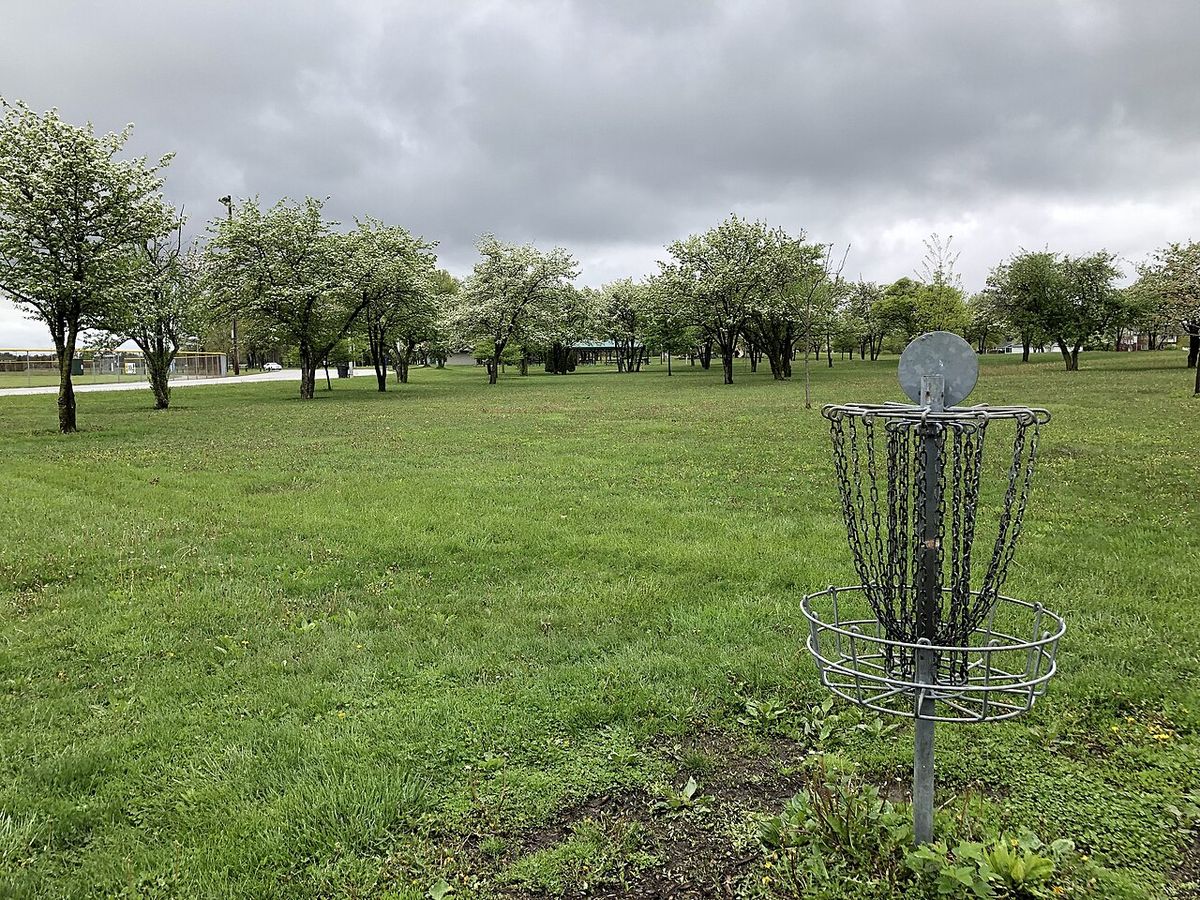
A disc golf course is designed with a series of holes, each consisting of a tee area and a target. The Professional Disc Golf Association recommends that holes average between 200 and 400 feet in length, though some championship holes exceed 1,500 feet. Designers use natural and artificial obstacles like trees, water hazards, elevation changes, and mandatory flight paths to create strategic challenges. Most courses are built in natural environments with minimal maintenance, and over 80 percent are public and free to play. The tee area is typically a pad made of concrete, asphalt, rubber, gravel, or artificial turf, with the PDGA recommending a minimum size of 1.2 meters wide by 3 meters long. Each hole is marked by a sign detailing the layout, distance, par, and any hazards or mandatory paths.
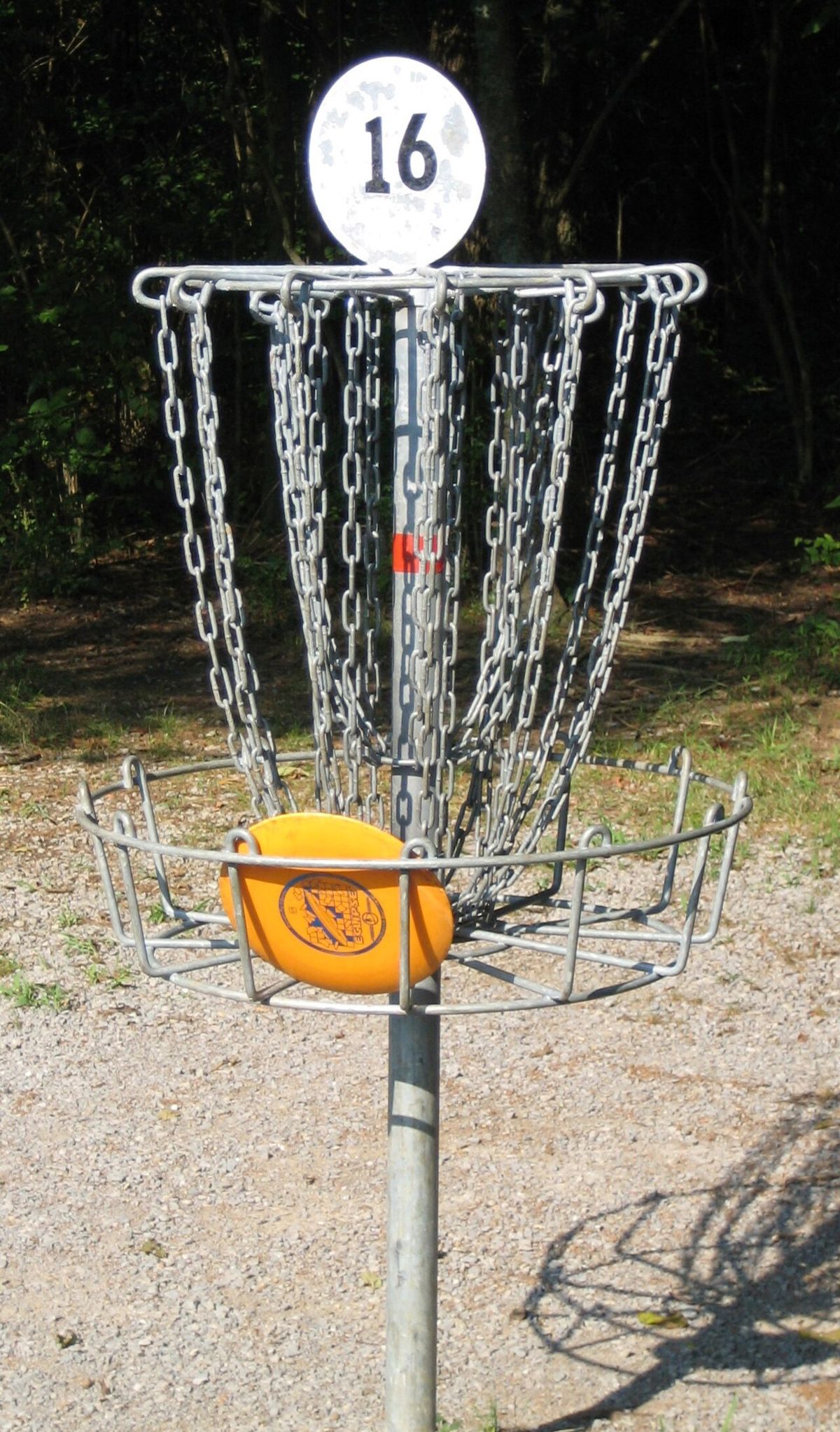
The standard target in modern disc golf is the basket, a metal structure with chains suspended above a catching tray. The chains are designed to catch and deflect the thrown disc into the basket below. According to official rules, a hole is completed when the disc comes to rest supported by the basket tray or the chains. While early courses used trees, fence posts, or park equipment as targets, the basket's consistent design has become central to the sport's uniformity. Some courses may also use alternative targets, such as tone poles that produce a sound when struck. The design prioritizes safety, aiming to minimize the danger of being hit by a disc while providing a variety of shot requirements.
- Common hole totals: 9, 18, 6, 12, 21, 24, or 27 holes.
- Recommended tee area size: 1.2 meters wide by 3 meters long.
- Percentage of courses listed as public and free: Over 80%.
- Primary target type: Disc golf basket with chains and tray.
- Early target examples: Trees, 50-gallon trash cans, gazebos, fence posts.
- Key design considerations: Safety, shot variety, strategic obstacles.
Gameplay and Rules
A round of disc golf involves playing a set number of holes, usually 9 or 18, with the goal of completing the course in the fewest total throws. Players begin each hole by throwing from the designated tee area, ensuring they do not cross the front line before release. They then proceed by throwing from where the disc lands until it comes to rest in the target. Play typically proceeds in groups of five or fewer, with the player farthest from the hole throwing first on subsequent shots. The order of play on the tee is traditionally determined by the scores on the previous hole, with the lowest scorer throwing first.
Safety and courtesy are fundamental aspects of gameplay. Players must ensure no one is within range before throwing and should avoid making distracting noises or movements while others are preparing their shots. The PDGA explicitly advises players never to throw into a blind area or when pedestrians are within range. Courses often incorporate out-of-bounds zones. Landing a disc in these areas usually incurs a one-throw penalty, and play resumes from a designated point or drop zone. Some holes also feature mandatory paths, requiring the disc's flight to pass on a specific side of an obstacle. Formal competition is governed by the comprehensive PDGA Official Rules of Disc Golf and the PDGA Competition Manual.
Discs and Flight Characteristics
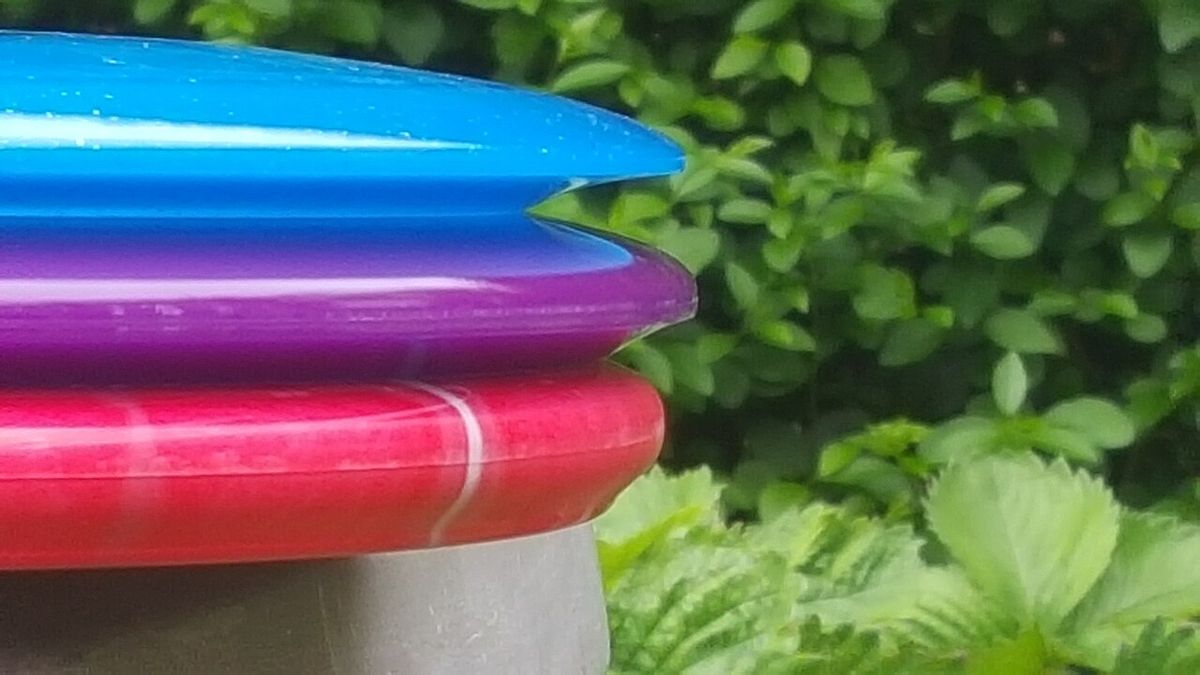
Disc golf discs are smaller and heavier than general-purpose frisbees, typically measuring 21-22 cm in diameter and weighing 130 to 180 grams. All PDGA-approved discs must be no more than 30 cm in diameter and 200 grams in weight. They are designed for specific flight patterns and are categorized into three main types: drivers, mid-range discs, and putters. Drivers have sharp, beveled edges and are engineered for maximum distance and speed, making them the choice for tee shots and long fairway throws. Mid-range discs offer more control with a moderate rim width and are often used for approach shots. Putters are designed for slow, predictable flight and are used for short-range shots close to the basket, where accuracy is paramount.
The flight of a disc is significantly influenced by its stability, which describes its tendency to bank laterally. For a right-handed backhand throw, an overstable disc will curve left, while an understable disc will curve right. Manufacturers rate stability using different systems. Innova uses turn and fade ratings, where turn measures high-speed stability on a scale from +1 to -5 and fade measures low-speed stability on a scale from 0 to 6. Discs are made from various plastic blends, which affect grip, durability, and flight. Base plastics like DX or Pro-D are more affordable, while premium plastics like Champion, Star, or Titanium are more durable. The spin of a disc provides gyroscopic stability, resisting roll and influencing its predictable fade at the end of the flight.
- Disc diameter range: 21-30 cm (PDGA approved).
- Disc weight range: Up to 200 g (PDGA maximum).
- Primary disc categories: Drivers, mid-range discs, putters.
- Innova stability ratings: Turn (+1 to -5), Fade (0 to 6).
- Example plastic blends: DX (base), Champion (premium), GStar, Titanium.
- Flight influence: Spin adds gyroscopic stability, affecting fade.
Throwing Techniques and Styles
Players employ several throwing techniques to manage a course's challenges, with the backhand and forehand throws being the most common. The backhand throw involves drawing the disc across the front of the body, generating power from the feet through the hips and shoulders to create high spin and distance. The forehand or sidearm throw is executed by drawing the disc from behind and across the body in a motion similar to a baseball sidearm throw. Each technique produces a different natural flight path, or hyzer. For a right-handed backhand, the disc naturally falls left, while a right-handed forehand causes it to fall right. An anhyzer release makes the disc fall against its natural pattern.
To manage obstacles like trees or bushes, players use a variety of alternative throws. The overhand tomahawk or hatchet throw involves gripping the disc similarly to a forehand but releasing it with an overhand motion, causing it to fly in a vertical arc. Other specialized throws include rollers, where the disc is thrown to land on its edge and roll along the ground, and grenade shots. Some disc models are specifically designed as roller discs. Mastery of different throws allows players to shape shots around obstacles and adapt to complex course layouts. The choice of grip and whether to use a run-up on the tee pad also varies significantly between players.
Global Reach and Canadian Context
Disc golf is played in approximately 40 countries, with a global network of over 16,000 courses. The United States accounts for about 75 percent of all courses, followed by Finland at 7 percent and Canada at 3 percent, meaning these three countries host 85 percent of the world's disc golf venues. Other nations with significant numbers of courses include Sweden, Estonia, Japan, Australia, New Zealand, and South Korea. Estonia has the highest density of courses per square kilometre of dry land and the second-highest number per capita. Courses exist on every continent, including 24 in Latin America, 8 in Africa, and one in Antarctica. The Åland region has the densest concentration, with one course in each of its 16 municipalities.
In Canada, disc golf has established a strong foothold, reflected in its position as the third-largest contributor to the global course count. Canadian courses are predominantly public and free, aligning with the global trend of accessible, community-focused recreation. The sport's growth is supported by the Professional Disc Golf Association, which reported 330,400 total members and 112,509 subscribed members worldwide as of 2026. Local clubs often form around courses, fostering community events, leagues, and tournaments. The design of Canadian courses frequently incorporates the country's diverse natural landscapes, utilizing forests, hills, and water bodies to create challenging and scenic playing experiences. The sport's accessibility and low cost contribute to its popularity across the country.
| Country/Region | Notable Fact |
|---|---|
| United States | 75% of world's disc golf courses |
| Finland | 7% of world's courses. 111 courses per million inhabitants |
| Canada | 3% of world's courses |
| Estonia | Highest course density per km². Second-highest per capita |
| Iceland | 150 courses per million inhabitants |
| Åland | One course in each of 16 municipalities |
Competition, Records, and Organization
Organized disc golf competition operates under the sanctioning and rules of the Professional Disc Golf Association. The PDGA oversees a worldwide tour of professional events, including major championships, where players compete for titles and prize money. Tournaments are structured across multiple divisions based on skill level, age, and gender, ensuring competitive opportunities for players of all abilities. At the professional level, players must demonstrate mastery of various shot types, strategic course management, and consistency under pressure. The PDGA also maintains official player ratings used for division placement and rankings.
Notable records in the sport highlight the extremes of human performance and equipment capability. The world record for the longest disc golf throw is held by David Wiggins Jr., who achieved a distance of 1,108.92 feet on March 28, 2016. This broke the previous record of 863.5 feet set by Simon Lizotte on October 25, 2014. These records are set under specific conditions for maximum distance throws, which differ from the controlled accuracy required on standard course holes. Other competitive records include lowest scores on championship courses, most tournament wins, and longest consecutive streaks of competition. The commercial side of the sport involves numerous manufacturers producing discs, baskets, and accessories, with companies like Innova and Discraft offering extensive product lines with different plastic blends and stability ratings.
Questions about Disc golf
How is disc golf scored?
Disc golf uses a scoring system identical to traditional golf, where the objective is to complete each hole in the fewest number of throws. The total number of throws for the entire course is the player's score, with the lowest score winning. Each hole has a par, which is the expected number of throws for a skilled player to complete it. Players often keep score on paper or using mobile applications designed for the sport. Penalty throws are added for discs landing out-of-bounds or for rule infractions.
What equipment do I need to start playing disc golf?
To begin, a player needs at least one disc, though most players carry a small selection. A starter set typically includes a driver, a mid-range disc, and a putter. Comfortable footwear is also recommended, as play involves walking the length of the course. Since the majority of courses are free and public, no additional fees or membership is required to play recreationally. Many courses have maps or signs to guide new players, and players may also use a mini marker disc to mark their lie during formal play.
Are disc golf courses free to play?
Yes, the vast majority of disc golf courses are free and open to the public. Over 80 percent of courses listed on major directories are public and do not charge a fee for play. This accessibility is a fundamental aspect of the sport's philosophy and a key driver of its growth. Some privately-owned or specially-maintained courses may charge a small fee, but these are the exception rather than the rule. The low cost contributes to the sport's broad appeal.
What is the PDGA and what does it do?
The Professional Disc Golf Association (PDGA) is the international governing body for the sport. It establishes the official rules, sanctions tournaments, maintains player ratings and rankings, and oversees the growth of disc golf globally. It also provides resources for course development, supports local clubs, and organizes professional tour events and amateur competitions. The PDGA Competition Manual details procedures for sanctioned events.
What is the difference between a driver and a putter?
Drivers and putters are designed for completely different purposes. Drivers have sharp, beveled edges and are built for speed and maximum distance, making them ideal for long tee shots. Putters have a blunt edge and are designed for slow, stable, and predictable flight, which is crucial for accurate short-range shots near the basket. The weight distribution and aerodynamic profile of each disc type create these distinct flight characteristics. Players often carry multiple putters with different stability ratings for various short-game scenarios.
How many disc golf courses are there in Canada?
Canada accounts for approximately 3 percent of the world's disc golf courses. With a global total of over 16,000 courses, this translates to several hundred courses across the country. Canadian courses are spread from coast to coast, often located in public parks and natural areas, providing accessible recreational opportunities in both urban and rural settings. The number continues to grow as the sport's popularity increases, supported by local clubs and the PDGA's promotional efforts.
Sources and further reading
- Disc golf (Wikipedia)
- HIAARO Disc Golf Starter Discs Set | U.S. Landmark Series (brsbattery.com)
- Negative Disc Golf Landmark Flight Numbers: 3 / 5 / 0 / 0 (discfield.com)
- Summer Disc Golf (whistlerolympicpark.com)
- Disc Golf at Coal Creek Historic Park (cumberland.ca)
Checked by the Your Space Hamilton desk. Last updated 2026-10-21.