Airboat
An airboat is a flat-bottomed watercraft propelled by an aircraft-type propeller and powered by either an aircraft or automotive engine. It is commonly used for fishing, hunting, recreation, and ecotourism, particularly in marshy or shallow areas where traditional boats with submerged propellers are impractical. The airboat was invented in 1905 in Nova Scotia, Canada, by Alexander Graham Bell, with its first military deployment occurring a decade later. Its unique design has made it indispensable for rescue operations in floods and on ice, as well as a staple of transportation and tourism in regions like the Florida Everglades and Louisiana bayous.
Design and operation
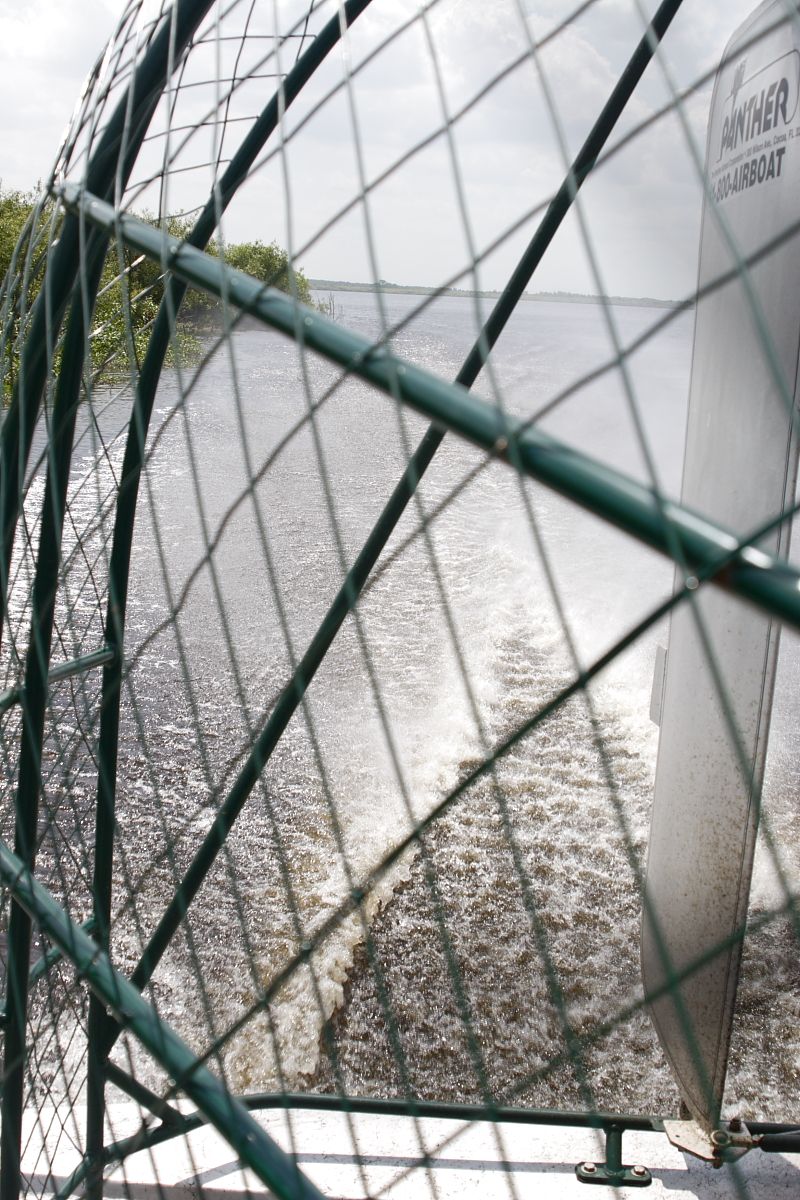
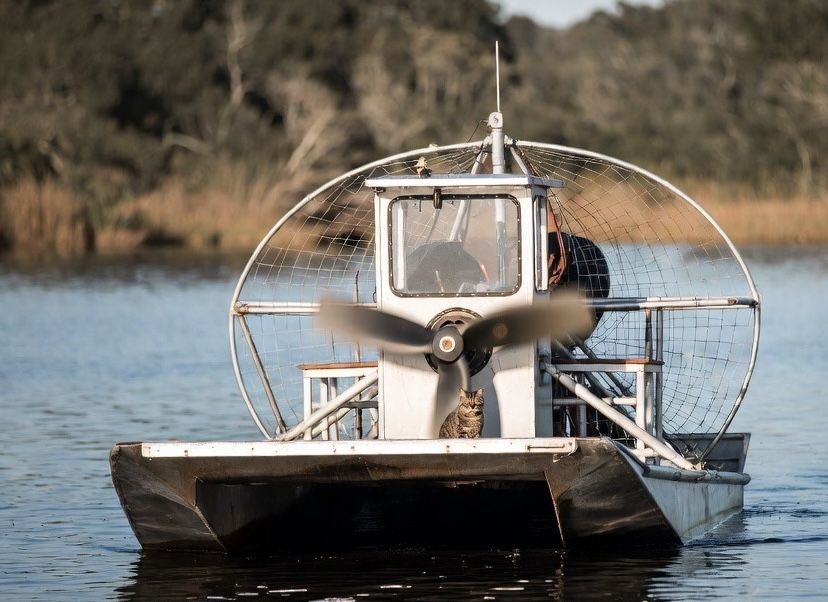
The fundamental design of an airboat centres on a flat-bottomed hull that allows it to glide over shallow water, marshes, and even ice with minimal draft. Propulsion is provided by a large, aircraft-type propeller mounted at the stern, which pushes a column of air to move the vessel. This propeller is always enclosed in a protective metal cage to prevent contact with debris, wildlife, or passengers. Steering is accomplished using air rudders positioned behind the propeller, which divert the thrust, typically controlled by a joystick or control stick from an operator's seat placed higher than the rest of the boat to see over vegetation. Most airboats cannot travel in reverse, and stopping requires more distance than conventional boats because they ride on top of the water rather than displacing it. The propeller generates wind speeds up to 150 miles per hour, and rudders attached to a control stick direct this air to change direction.
Hulls are typically constructed from aluminum or fiberglass, with the choice often dictated by the operating environment. Boats intended for icy conditions may use sturdier, polymer-coated aluminum, while lighter fiberglass is common for marshy areas. Engine options include air-cooled aircraft engines or more common, less expensive water-cooled automotive V8 engines, with power ranging from 50 to over 600 horsepower. Modern designs have incorporated mufflers and multi-blade carbon-fiber propellers to significantly reduce noise levels compared to earlier models. Standard recreational or hunting boats are often around 10 feet long with a two- to three-passenger capacity, while commercial tour boats can be much larger, accommodating 18 or more passengers. In a developing country like Iraq, an airboat could be purchased for as little as 2.5 million Iraqi dinars, or about $2,147, illustrating a wide range in production cost and market.
Historical development
The concept of the airboat originated in 1905 in Nova Scotia, where Alexander Graham Bell and his team built the Ugly Duckling, a catamaran-type vessel powered by an aircraft engine and propeller for engine testing. Although slow, it demonstrated the principle. Similar experimental craft followed, including one built by Brazilian pioneer Alberto Santos-Dumont in 1907. The first practical military application came in 1915 during the First World War, when the British Army used small, flat-bottomed 'Hydro-Glisseurs' built by the De Lambert company for reconnaissance on the Tigris River in Mesopotamia. These early vessels, steered by a water rudder, saw service through the 1918 Armistice and were later used as ferries in China and on the Missouri River. A dedicated repair slipway for these boats was built at the Motor Repair Dockyard in Baghdad, indicating their importance to the British war effort and the difficulty of maintaining them.
In the United States, independent development began in the 1920s and 1930s. Aviation pioneer Glenn Curtiss built a closed-cabin, propeller-driven boat called Scooter in 1920 for hunting in Florida. Throughout the 1930s, Floridian outdoorsmen like Johnny Lamb and the Yates brothers built their own crude airboats for moving through the Everglades. A crucial improvement in design occurred in 1943 in Utah, where Cecil Williams, Leo Young, and G. Hortin Jensen developed an airboat for conducting botulism studies at the Bear River Migratory Bird Refuge. Their aluminum boat, powered by a 40-horsepower aircraft engine bought for $99.50, was the first to use an air rudder for steering, which directs the propeller exhaust instead of using a water rudder. Many early boats built at the refuge were subsequently shipped to Florida, with early records showing a build cost of roughly $1,600 per boat including the engine.
Manufacturing and commercial use
Airboat manufacturing is largely dominated by small, family-run businesses that assemble boats to order. While most production occurs in the United States, airboats are also built in countries including Russia, Italy, Finland, Japan, and Australia. Prior to 1950, most airboats were manufactured in France by companies like Farman and De Lambert. The commercial airboat industry is closely tied to ecotourism and recreational activities in suitable geographic regions. In Florida, as of December 2017, there were 12,164 registered airboats, of which 1,025 were used for commercial purposes such as guided tours. Airboats are also widely used in other Gulf Coast states, especially Louisiana, for similar activities. Their specialized design and limited mobility beyond shallow waters mean they represent only a small fraction of total watercraft worldwide.
The cost of an airboat varies significantly based on its size, engine, and customization. In 2004, a typical good-quality airboat in the United States cost between $33,000 and $70,000. In contrast, in a developing country like Iraq, an airboat could be purchased for as little as 2.5 million Iraqi dinars, or approximately $2,147 at the time. The French company Farman marketed civilian airboats in the 1920s for 25,000 to 50,000 francs, a price that proved too steep for buyers and led the company to exit the boat business by the decade's end. Early European airboats differed from modern versions, being larger with higher freeboards, lacking a propeller cage, and using a steering wheel and water rudder instead of a joystick and air rudder.
Safety and regulation
Operating an airboat presents unique safety challenges due to its design. The craft is top-heavy and has an extremely shallow draft, making it prone to capsizing, particularly in open or rough water. Between 2014 and 2017, over 75 airboat accidents were recorded in Florida, resulting in seven deaths and 102 severe injuries. A 2017 analysis by the Miami New Times found that 64 percent of these accidents were due to operator error, stemming from a lack of training, failure to use safety equipment like seatbelts and life jackets, or reckless behaviour such as operating under the influence of drugs or alcohol. Five of the seven fatalities were drownings, with 90 percent of victims not wearing life jackets and only 30 percent of accident victims knowing how to swim. Forty percent of injured victims and the only two non-drowning fatalities were thrown from their seats during crashes.
In response, Florida has implemented specific regulations for airboat operation. Since 2018, operators are required to complete a CPR instruction course and an airboat-specific course run by the state's wildlife commission. State law also mandates that airboats must be equipped with an adequate muffling device for the engine exhaust, such as an automotive-style factory muffler or underwater exhaust, and must fly an international orange flag of at least 10 by 12 inches from a mast that stands at least 10 feet above the boat's lowest point to increase visibility. The minimum age to operate an airboat in Florida is 14 years old. Safety features on the boats themselves include the mandatory protective cage around the propeller and optional auto-inflation devices to reduce capsizing risk. Some designs, like those with a long-belt gear reduction drive unit that mounts the automobile engine inside the hull, lower the centre of gravity to improve stability.
Rescue and public safety applications
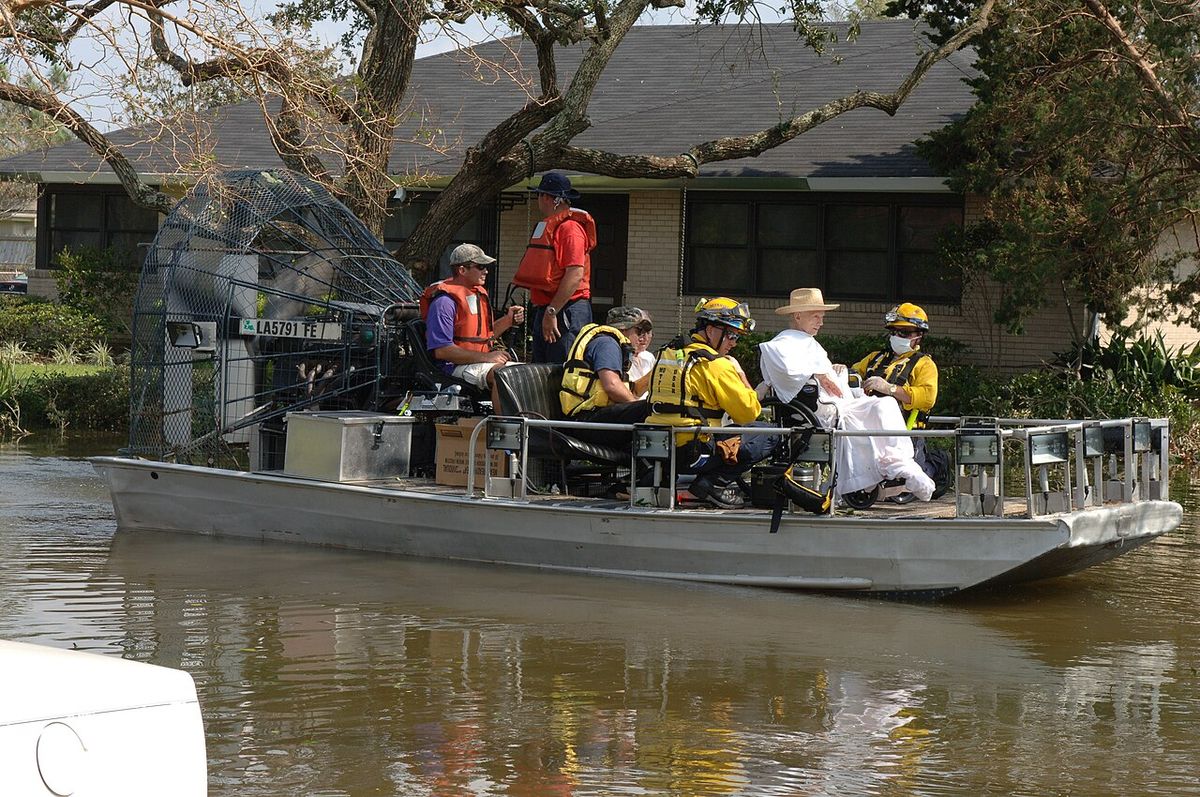
Airboats have become vital tools for public safety agencies, excelling in flood, shallow water, and ice rescue operations where traditional boats cannot function. Their ability to move over obstacles, partially submerged debris, and even ice makes them uniquely effective. During the flooding of New Orleans after Hurricane Katrina in 2005, a volunteer flotilla of 30 airboats, often called the 'Cajun Navy', evacuated over 1,100 patients and 4,000 medical personnel and family members from four downtown hospitals in less than 36 hours. This grassroots model of volunteer airboat rescue has since been deployed during other disasters like Hurricane Harvey and Hurricane Florence. Trade journals such as Fire Engineering and National Fire and Rescue Magazine have published articles detailing the advantages and real-world use of airboats in water rescue.
In ice rescue scenarios, airboats dramatically improve response times. Data from Minnesota fire departments indicates that using an airboat can reduce the average rescue time from 45-60 minutes to just 7-12 minutes. They are faster, larger, and more durable than the small inflatable boats typically used for such operations. The lack of operating parts below the waterline makes the craft ideal for rescue work in debris-filled water. However, a significant operational hazard exists when airboats and helicopters work in the same area. The rotor wash from low-flying helicopters can push airboats off course or even capsize them, as reported during post-Katrina operations when one airboat was overturned and others were blown into buildings, utility poles, and bridge pilings.
Military and specialized variants
Airboats have seen military service in various conflicts since their first use in 1915. The British Army employed them in the Mesopotamian Campaign of the First World War. During the Vietnam War, the U.S. Special Forces and South Vietnamese troops used Hurricane Aircat airboats to patrol riverine and marshy areas. Two of these airboats were later captured by the People's Army of Vietnam and used by the Khmer National Navy. In more recent conflicts, airboats have been utilized by Iraqi security forces. They are also used by border patrols and the U.S. Coast Guard. Beyond true watercraft, the Soviet Union and its successor states have extensively used a related hybrid vehicle known as an aerosled or 'aerosani'.
These aerosleds function as amphibious vehicles, combining elements of a sled, airboat, and ground-effect vehicle. Thousands have been used for cargo and passenger transport in Siberia, where they perform well in both icy winter conditions and the muddy rasputitsa (spring thaw) season. The Tupolev A-3 Aerosledge is a clear example of this type of vehicle, capable of speeds up to 120 km/h on snow and 65 km/h on water. These vehicles remain in use today, demonstrating the versatility of the air-propulsion principle across different terrains. During the Second World War, the Soviet military used true airboats like the armed NKL-5, which weighed 1,200 kilograms and could reach 60 kilometres per hour.
Notable incidents and records
The history of airboating includes several significant firsts and tragic milestones. Willard Yates, one of the Chokoloskee Gladesmen who built an airboat in 1935, has the unfortunate distinction of being the first person to die in an airboating accident when the engine dislodged and sent the spinning propeller into him. The first airboat, the Ugly Duckling, built by Alexander Graham Bell in 1905, was unable to move faster than 3.5 knots, though Bell believed it had a theoretical top speed of thirty or forty miles an hour. The French speedboat La Rapière II, built in 1907 by the Tellier brothers, could achieve 26 kilometres per hour with two people on board using a 20 hp engine and a partially above-water propeller. The boat was steered by a conventional rudder in the water hooked up to a ship's wheel, a design different from modern air rudders.
In rescue operations, airboats have set remarkable records for efficiency. The evacuation of four New Orleans hospitals in under 36 hours post-Katrina is a major achievement for volunteer airboat operators. The state of Florida's requirement for operator training, enacted in 2018, was a direct regulatory response to the accident statistics from the preceding years. The French financier Jacques Schneider, of Schneider Trophy fame, also developed and experimented with his own multi-passenger airboat around 1913 to 1914.
Key manufacturers and models
Throughout its history, airboat production has been undertaken by a mix of aviation pioneers and specialized small businesses. Early manufacturers were primarily French aviation companies. Later development shifted to custom builders in the United States and other countries. The design evolved through trial and error into an open, flat bottom boat with an engine mounted on the back, the driver sitting in a high position, and a cage to protect the propeller.
- De Lambert Hydro-Glisseurs (1915 to 1918): Purpose-built military airboats used by the British Army in Mesopotamia, later used as ferries in China and North America. They had a draft of only seven inches and could cruise at up to 32 miles per hour.
- Farman civilian airboats (1920s): Marketed for use as water taxis and light cargo vessels for French colonial governments, but discontinued due to high cost, selling for 25,000 to 50,000 francs.
- Glenn Curtiss's Scooter (1920): A closed-cabin, six-passenger boat built for hunting in the Florida backwoods, capable of 50 mph.
- Tupolev A-3 Aerosledge: A Soviet-era amphibious aerosled, representative of airboat-like vehicles used for transport in Siberia.
- Alligator I (1943): The airboat built in Utah by Williams, Young, and Jensen, named in response to a joking suggestion to use an alligator for transport in the marshes.
Airboat manufacturers tend to be small, family run businesses that assemble built-to-order boats. Most airboats are manufactured in the United States, although they are also built in Russia, Italy, Finland, Japan, Australia, and elsewhere. Modern, commercially manufactured airboat hulls are made of aluminium or fibreglass. The design continues to evolve with a focus on noise reduction through mufflers and multi-blade carbon-fibre propellers. Companies like Airboat West and organizations like the Los Alamos National Laboratory have built airboats with low centres of gravity for use in windy or rough conditions or in rescues with obstacles such as low-hanging power lines.
Questions about Airboat
Who invented the airboat?
The airboat was invented in 1905 in Nova Scotia, Canada, by Alexander Graham Bell and his team. Their prototype was named the Ugly Duckling and was built as a catamaran-type vessel to test aircraft engines. Although it was slow, Bell theorized that with reduced drag it could reach speeds comparable to some modern airboats. The first airboats to see practical use were built for the British Army in 1915 for the Mesopotamian Campaign of the First World War.
Why are airboats used in the Florida Everglades?
Airboats are ideal for the Florida Everglades because of the region's vast, shallow marshes and grassy wetlands. A standard boat with a submerged propeller would be constantly fouled by vegetation and mud. The airboat's flat bottom allows it to glide over these shallow waters, and its aircraft propeller, which operates entirely in the air, is unaffected by underwater obstacles. This makes the airboat the primary means of transportation for fishing, hunting, tourism, and research in the Everglades ecosystem.
How fast can an airboat go?
Airboats generally cruise at speeds around 35 miles per hour (55 km/h). However, with modifications, they can achieve much higher speeds. Some modified craft have been recorded reaching 135 miles per hour (215 km/h). The speed is generated by the propeller, which can create a column of air moving at up to 150 miles per hour (241 km/h). Steering at high speeds is managed by air rudders that divert this thrust.
Are airboats safe?
Airboats have specific safety considerations. They are top-heavy and can capsize, especially in rough water. Statistics from Florida between 2014 and 2017 show over 75 accidents resulting in seven deaths, with most drowning victims not wearing life jackets. Key safety features include a protective cage around the propeller, seatbelts, and the use of life jackets. Operator error is a major factor in accidents, leading Florida to mandate safety training courses for all airboat operators since 2018.
What is the difference between an airboat and an aerosled?
An airboat is a watercraft designed to operate on water, though it can traverse very shallow marshes. An aerosled (or 'aerosani'), commonly used in Russia, is a hybrid amphibious vehicle designed primarily for snow and ice but which can also operate on water. It combines features of a sled, airboat, and ground-effect vehicle. While both use an aircraft propeller for propulsion, aerosleds are built for overland travel in conditions like the Siberian winter, whereas airboats are specialized for aquatic environments.
How are airboats used in rescue operations?
Airboats are highly effective for flood, shallow water, and ice rescue operations, proving indispensable for public safety uses. Their partially amphibious nature allows them to handle effectively over obstacles like partially submerged buildings, wreckage, or sea ice that would stop a normal boat. During the flooding of New Orleans following Hurricane Katrina, thirty airboats crewed by civilian volunteers evacuated over 1,100 patients and 4,000 medical personnel from hospitals in less than 36 hours. In ice rescues, data from Minnesota fire departments shows airboats cut the average rescue time from 45 to 60 minutes down to seven to 12 minutes. They are also faster, larger, safer, and more durable than other small boats used in such rescues, though they can be vulnerable to rotor wash from low flying helicopters.
Sources and further reading
- Airboat (Wikipedia)
- Touring the Everglades by Airboat (visitflorida.com)
- Everglades Holiday Park: 14 Fun Facts About Airboat Rides (evergladesholidaypark.com)
- BBQ Pig & Airboat Inflatable for Event Marketing (landmarkcreations.com)
- History of Airboats (evergladessafaripark.com)
Checked by the Your Space Hamilton desk. Last updated 2026-10-22.