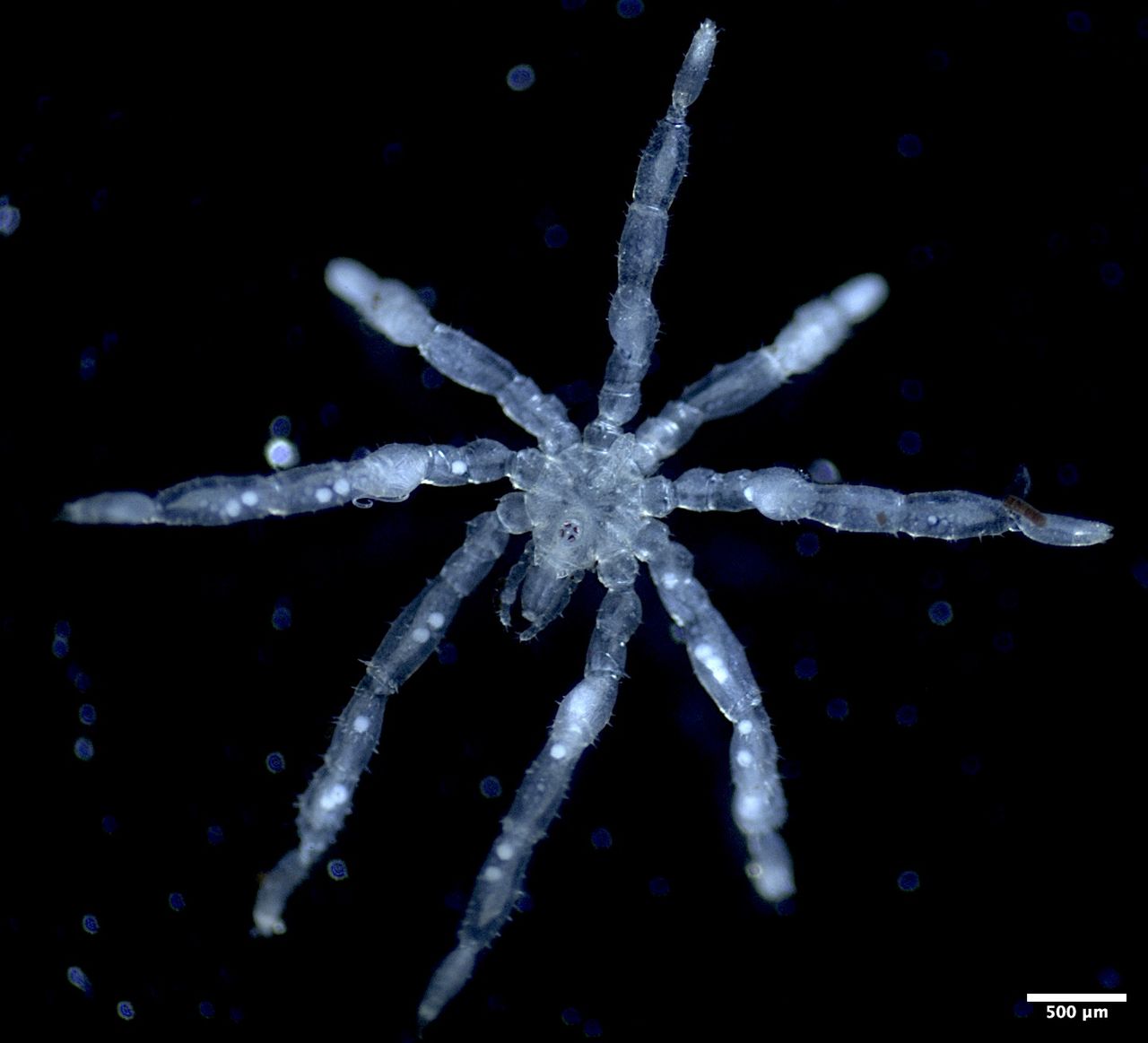
Hairy-legged sea spiders discovered in B.C. waters are first new species documented in Salish Sea in a century
UBC researchers have identified two new species of sea spiders, including one with hairy legs and red eyes, marking the first such discovery in the Salish Sea in nearly 100 years.
Researchers at the University of British Columbia have made a significant marine discovery that highlights the rich biodiversity of British Columbia's coastal waters. Two new species of sea spiders, collected between September 2023 and August 2024, represent the first such findings in the Salish Sea region in nearly a century. These tiny marine arthropods were found in multiple locations including Vancouver, Quadra Island, Bamfield, and Victoria, demonstrating the widespread distribution of these creatures in Pacific Northwest waters.
Distinctive features of the new species
The first species, named Callipallene pilosuspedes, presents a striking appearance that might unsettle swimmers. Its Latin name translates to "hairy feet," a reference to the long, curved spines covering its lower legs that give it a distinctly fuzzy appearance. According to UBC researchers, this creature has multiple specialized features including red eyes, a short proboscis equipped with claws for grasping food, and a triangular mouth with three lips covered in sensory tendrils. The university's description compares its mouth to "a tiny marine Sarlacc pit," referencing the fictional creature from Star Wars known for its terrifying maw.
This species also demonstrates sophisticated self-care behaviors through specialized appendages used for grooming. Such physical characteristics and behaviors provide insight into the evolutionary adaptations that have allowed sea spiders to thrive in marine environments for hundreds of millions of years.
READ MORE: Cold case reignited as homicide investigators return to Bowen Island in search for Jodi Henrickson
READ MORE: Canadian home prices rose for first time in over a year, BIS data shows
Cultural significance of the second species
The second newly discovered species, Tanystylum kiixin (pronounced "kee-hin"), carries cultural significance through its naming. Researchers chose to honor the ancient Indigenous village located near where the creature was found. This naming practice reflects growing recognition of Indigenous connections to land and sea in scientific research.
Unlike its hairy-legged counterpart, this species has small limbs that limit its grooming ability. Lead researcher Cormac Toler-Scott observed that this characteristic often leaves the creature covered in debris and tiny parasites, creating what he describes as "an ecosystem within an ecosystem within an ecosystem." This observation highlights how even individual marine organisms can support complex microhabitats, contributing to broader marine biodiversity.
Evolutionary history and biological characteristics
Sea spiders represent an ancient lineage of marine arthropods that first appeared approximately 500 million years ago. Despite their name, they are not true spiders but share evolutionary relationships with scorpions, spiders, and horseshoe crabs. These creatures display remarkable size variation, ranging from less than a centimeter to over 70 centimeters in length, with some species possessing up to twelve legs.
"They've retained some weird traits," explained Toler-Scott, detailing their parasitic behaviors. Many shallow water species live as parasites on larger organisms, using their specialized proboscis to extract nutrients from hosts. This feeding strategy represents one of many evolutionary adaptations that have allowed sea spiders to occupy diverse ecological niches throughout their long evolutionary history.
Scientific importance of the discovery
The identification of these species marks the first new sea spider documentation in the Salish Sea region in nearly a century, suggesting that even well-studied marine environments may harbor undiscovered biodiversity. The relatively short duration of the field season that yielded these discoveries points to the potential for additional undocumented species in the area. "There's definitely more diversity out there that we haven't documented," Toler-Scott acknowledged, hinting at opportunities for future research.
Both new species have been formally registered in global scientific databases, ensuring their recognition by the international scientific community. This step represents a crucial part of documenting and preserving knowledge about marine biodiversity, particularly as environmental changes threaten ecosystems worldwide.
Ecological implications and research value
These discoveries carry important implications for understanding marine ecosystems. The presence of distinct species in relatively accessible waters near populated areas underscores how much remains unknown about marine biodiversity, even in regions subject to scientific study. The findings contribute to broader knowledge about evolutionary relationships among arthropods and the development of specialized traits in marine environments.
The research also provides valuable insights into the complex relationships between marine organisms, from parasitic feeding behaviors to the micro-ecosystems that develop on individual creatures. Such knowledge enhances our understanding of marine ecology and may inform conservation efforts aimed at protecting vulnerable species and habitats.
Future directions for marine research
The success of this relatively brief research effort suggests significant potential for future discoveries in British Columbia's coastal waters. The Salish Sea, while subject to various human impacts, continues to reveal new aspects of its biodiversity through focused scientific investigation. These findings may inspire additional research into lesser-studied marine organisms and their ecological roles.
As climate change and other environmental pressures affect marine ecosystems, documenting existing biodiversity becomes increasingly important. Discoveries like these provide baseline data that can help scientists monitor changes in species distribution and abundance over time, contributing to more effective marine conservation strategies.