Fear and division mark final month of Alberta's historic separation referendum campaign
With one month until Alberta votes on its future in Canada, campaigners report threats, vandalism and deep emotional divides over the province's potential separation, as historical grievances collide with modern political tensions.
As Alberta enters the final stretch before its October 19 referendum on potentially leaving Canada, the province finds itself grappling with an intensity of political division rarely seen in Canadian politics. What began as a policy debate has transformed into an emotional reckoning about identity, history and Alberta's place in Confederation, with reports of vandalism, threats and deeply personal conflicts emerging from both sides of the campaign.
The battle for public space
The physical landscape of Alberta communities has become a visible battleground in this referendum campaign. Neighborhoods display competing visions through lawn signs - red and white "Forever Canada" markers facing off against blue separatist signs. Keith Wilson, co-leader of the pro-separation Let Alberta Decide campaign, explained the strategic challenges this presents. "We've had people who are supportive but don't want to put a lawn sign on their home out of fear that their car will get keyed in the driveway," Wilson told CityNews. This climate of apprehension has forced campaigners to adapt their strategies, with Wilson's group focusing on digital outreach and installing oversized signs on public property rather than relying on residential displays.
Cory Morgan, a political commentator and organizer with the Pathway to Independence separatist group, noted a similar dynamic at play. Despite receiving a $1,000 donation from one supporter, Morgan recounted how the individual refused to display a lawn sign, reflecting widespread caution among separatist backers. However, Morgan observed a gradual shift as the campaign progresses: "When they see a neighbour or two put one of those signs out, they feel more comfortable doing it as well." This cautious emergence of public displays speaks to the charged atmosphere surrounding the referendum.
READ MORE: Ottawa City Council Votes to Rename Trump Avenue Amid Political Tensions
READ MORE: Quebec Election Parties Sharply Divided Over Immigration and French Language Policies
Emotional fault lines
The campaign has exposed raw emotional divides that extend far beyond typical policy disagreements. Former Alberta deputy premier Thomas Lukaszuk has been touring the province in a distinctive pink and red RV dubbed the "Unity Bus," advocating for Alberta to remain in Canada. His efforts recently met with physical resistance when someone shattered a window on the bus. Lukaszuk described encountering profound emotional responses at stops across Alberta. "I've never seen as much crying, both from women and men, because they're worried about what's happening," he told CityNews. These reactions underscore how the referendum has become a deeply personal matter for many Albertans, touching on questions of identity and belonging.
Both campaigns now view voter mobilization rather than persuasion as the decisive factor. Lukaszuk summarized this consensus: "The vote is already baked in, and it's all about voter turnout." Election officials have reported unprecedented early engagement, with more than half a million Albertans requesting mail-in ballots for the single-question referendum that asks whether the province should remain in Canada or prepare for a binding separation vote.
Historical roots of discontent
The current separatist movement draws from deep wells of historical grievance in Alberta. The 1980s National Energy Program under Prime Minister Pierre Trudeau, which artificially depressed oil prices in the name of Canadian sovereignty, created lasting economic pain and political resentment in the resource-rich province. For decades, separatist sentiment remained a marginal political force, but the movement gained new momentum after Danielle Smith assumed leadership of the United Conservative Party in 2022. Her adversarial stance toward Ottawa and willingness to validate separatist concerns marked a significant shift in Alberta's political landscape.
The path to the current referendum began when the Stay Free Alberta petition collected sufficient signatures earlier this year, though a court initially blocked it over inadequate consultation with First Nations. Premier Smith's decision in May to override this ruling and unilaterally call the vote demonstrated her commitment to addressing what she frames as longstanding grievances against federal overreach.
Symbols and flashpoints
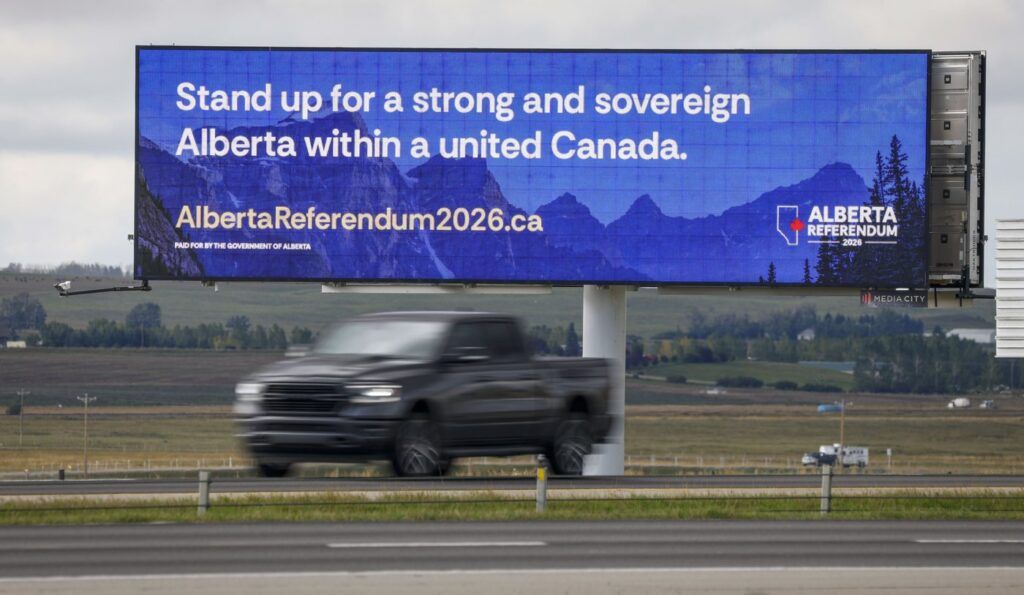
The campaign has transformed provincial symbols into political markers, with the Alberta flag increasingly adopted as a separatist emblem. This symbolic shift became particularly evident in Sundre this summer, when parade organizers cancelled the event after facing harassment for excluding a separatist-themed wagon displaying the flag. In Taber, a separatist billboard erected by Cory Morgan sparked a legal confrontation with town council, which ordered its removal. These incidents illustrate how ordinary community events and public spaces have become contested terrain in the referendum debate.
Federal politicians have entered the fray, with Prime Minister Mark Carney posing with Lukaszuk's Unity Bus during a cabinet retreat in Banff. Former Conservative cabinet minister Monte Solberg's Vote to Stay group has employed radio ads highlighting separatist connections to U.S. political figures, arguing that Alberta's independence would be untenable. "Separatists are kidding themselves if they think Alberta would remain independent for more than five minutes," Solberg asserted, framing the separatist position as unrealistic.
Leadership and political stakes
Premier Smith maintains that the referendum represents a legitimate response to Alberta's grievances and will provide much-needed clarity about the province's constitutional future. However, critics argue she has gambled with national unity to appease the separatist faction within her party. The ballot's inclusion of nine additional non-binding questions about provincial control over immigration and constitutional matters reflects Smith's broader push for Alberta autonomy within Confederation.
The campaign has produced unlikely alliances among former political adversaries. Former premiers Jason Kenney and Rachel Notley, along with Reform Party founder Preston Manning, have united in opposing separation. This convergence of figures from across Alberta's political spectrum underscores how the referendum has disrupted traditional partisan divides, creating new political dynamics that may persist regardless of the vote's outcome.
Broader implications
The Alberta referendum represents more than a provincial matter; it poses fundamental questions about Canadian federalism and the nature of political discontent in resource-dependent regions. The intensity of emotion and occasional vandalism reflect how economic grievances dating back to the 1980s energy disputes have become intertwined with questions of identity and political alienation in Alberta.
The campaign also tests the limits of direct democracy in constitutional matters, particularly after Smith bypassed legislative debate to call the vote based on citizen petitions. With record early turnout suggesting historically high engagement, the referendum's result could either defuse separatist sentiment or embolden similar movements in other provinces. The final month of campaigning promises to be one of the most consequential - and emotionally charged - periods in recent Canadian political history, with implications that will resonate far beyond Alberta's borders.
Looking ahead
As Albertans prepare to cast their ballots, the campaign's intensity shows no signs of abating. Both sides continue organizing rallies and events, aware that every vote may prove crucial in what promises to be a closely contested decision. The referendum has already revealed deep fractures in Alberta society and Canada's federal structure, ensuring that its impact will be felt long after October 19, regardless of which option prevails. What began as a political debate has become a moment of profound reckoning for Alberta and for Canada as a whole.