Soil health test with buried underwear spurs Ontario farmer to change practices
A farmer near Peterborough, Ont., says a simple test measuring microbial activity in his soil prompted him to adopt more sustainable farming methods.
PETERBOROUGH — An Ontario farmer says a simple, cheekily named test involving buried underwear revealed poor soil health on his farm and started him on a path to more sustainable practices.
Norm Lamothe, who runs the family-owned Woodleigh Farms outside Peterborough, Ont., first tried the "Soil Your Undies" test in 2015.
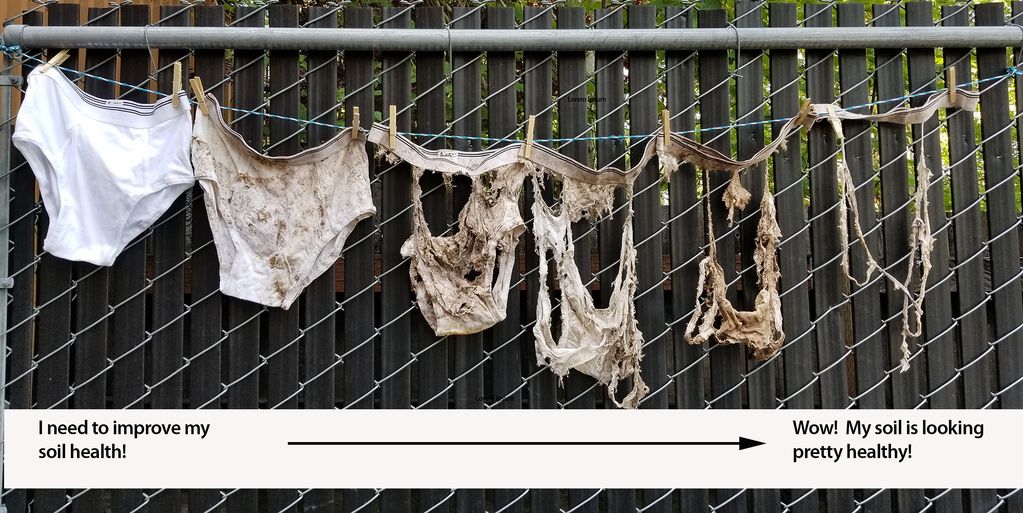
"That's really what started my journey down the soil health path," Lamothe said, standing in front of one full pair of Hanes and the tattered remains of another, lovingly displayed on his office wall. "Much to our chagrin, they were completely intact."
READ MORE: Nova Scotia Health pulls wildfire report after minister says she had 'no idea'
READ MORE: Fire officer says crews caught in cycle of wildfires and floods
He described it as a self-described "wake-up call" to improve his farm's practices for the climate, biodiversity and his own business resilience.
The test is popular in farm country as a simple way to measure how active tiny organisms like bacteria and fungi are in soil. A plain cotton undergarment is buried for two months and then dug up; more microbial activity means a more degraded garment.
After changing his farming techniques, Lamothe buried another pair. Two months later, the cotton fabric had largely disappeared, and mostly just the elastic waistband remained.
Lamothe joined peer groups like the Ontario Soil Network and Farmers for Climate Solutions for guidance, and to support others looking to make positive change.
His crop rotation was once dominated by corn and soybeans, the two most common field crops in Ontario. Adding wheat and oats was one of the first things he did after failing that initial undies test.
Long-term research trials from the University of Guelph have shown more diversity in crops helps build soil health, as well as crop yields.
On areas of the farm that have historically been less productive, he planted trees and native grasses. Cover crops, planted to improve soil, rather than for harvest and sale, will go on his winter wheat fields after harvest.
Reducing fossil fuel use is another priority. Lamothe said he "absolutely loves" his fully electric pickup truck, not least because it saves him about $6,500 a year in fuel.
His farm also features a greenhouse he calls a "passive solar" facility. It's built with a sloped roof to capture ambient heat, which is stored in ducts in the ground during the day and recovered in cooler months, keeping the greenhouse above freezing without additional heating.
Agriculture accounts for about eight per cent of Canada's national greenhouse gas emissions, or 10 per cent if you include emissions from energy use on farms.
The culprits are many: nitrous oxide can escape to the atmosphere from soil. Cattle, sheep and other ruminant livestock create methane through their digestive processes. And carbon dioxide is released by decaying plant matter and from burning diesel, the main fuel for most tractors and farm equipment.
Lamothe is among farmers and ranchers across Canada motivated by factors like water quality, biodiversity, profitability and resiliency in the face of extreme weather conditions like heat waves, floods and drought.
From his farmyard, the landscape is a mix of rolling pasture, cropland and woodland. When visited in July, his fields were flush with corn, soybeans and oats.
With files from The Narwhal