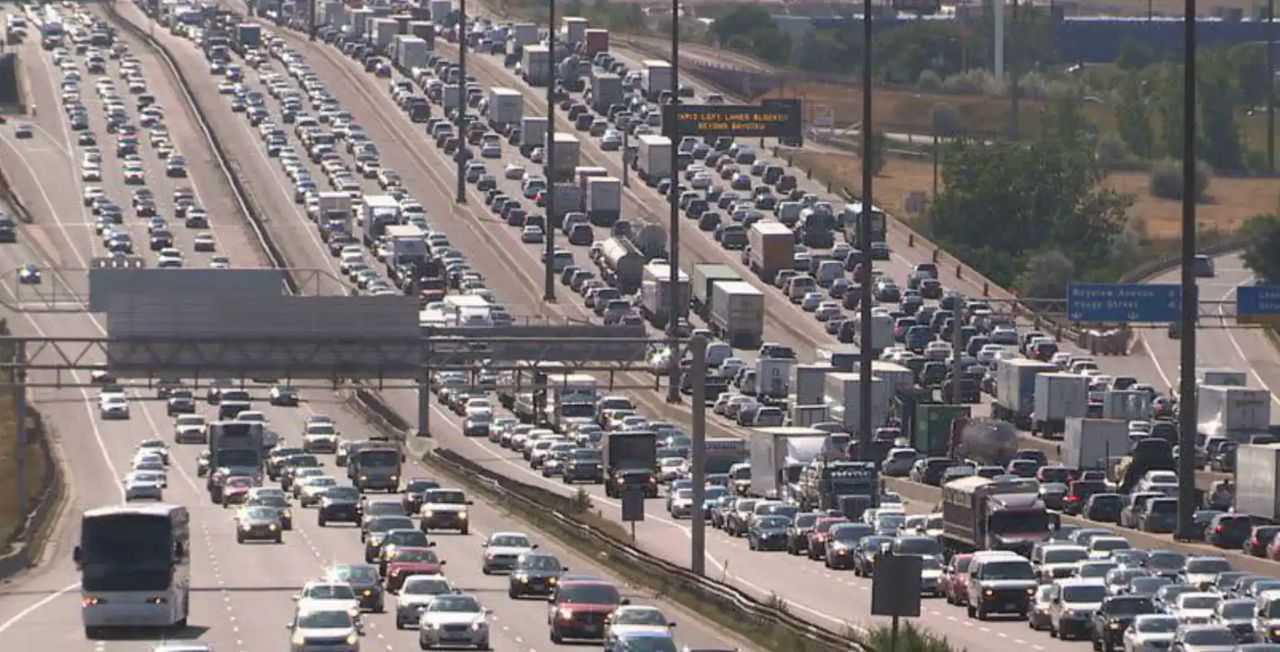
Experts propose $9 congestion levy for downtown Toronto to cut traffic
A $9 charge to enter the downtown core could reduce gridlock and fund transit improvements, researchers say.
TORONTO — University of Toronto researchers are proposing a $9 congestion charge for drivers entering downtown Toronto to curb gridlock and raise an estimated $500 million for transit.
Marianne Hatzopoulou and Steven Farber, along with Toronto's first "Bicycle Mayor" Lanrick Bennett Jr., say the toll would reduce traffic and push more people onto public transit.
"The evidence around congestion charging is really clear," said Farber, a human geography professor at U of T. "It's essentially one of the only things that we can do that actually helps bring down congestion levels in dense urban environments like downtown Toronto."
READ MORE: Fort St. John approves free transit for 2026 provincial election day
READ MORE: Hamilton council candidate opposes data centres, pledges housing and transit reforms
He said a congestion price would have two benefits: discouraging drivers from entering the city and collecting revenue that could then be spent on improving public transit.
The researchers propose a congestion zone bounded by St. Clair Avenue to the north, the Humber River to the west and the Don River to the east.
The $500 million revenue estimate does not include dynamic pricing, where prices would go up or down depending on the time of day.
The experts note there would also need to be some exceptions for lower-income drivers, and a commensurate improvement in the TTC to ferry more riders.
Congestion pricing has become a widely used tool across the world, implemented in some of the world's largest and most congested cities.
Traffic in London decreased by 30 per cent and average speeds rose by five kilometres an hour after its levy was introduced, according to the School of Cities.
Bus ridership in Singapore was boosted by eight per cent, and New York's congestion levy pulled in $550 million for the state government while boosting transit ridership by seven per cent.
Farber said Toronto isn't going to be building new highways or tearing down buildings to put in more roads that cut through the middle of the city.
"Therefore, our only real policy levers are to curb the demand for car use," he said.
A major obstacle is the provincial government. As part of its 2025 Bill 24, the province removed the city's power to toll highways.
That means the city would need to negotiate with the province to get approval for any kind of congestion charge in Toronto.
In response to the proposal, a spokesperson for Mayor Olivia Chow's team noted the city lacks the power to enact this levy, and the province has been clear it would not provide any such powers.
The statement said Chow, as mayor, appointed "the Toronto's first Chief Congestion Officer, hiring more than 100 traffic agents, expanding smart signals, shortening road closures and advancing a co-ordinated congestion action plan."
It added she plans to keep TTC fares frozen, introduce a 10 ride per week fare cap, and invest in better service.
A spokesperson for candidate Brad Bradford said, "Brad's focus is on the levers the City actually controls: construction co-ordination with one person accountable to the Mayor, published timelines and real consequences for projects that linger, traffic agents at the intersections that matter, transit lane enforcement, and a TTC reliable enough that people choose it, starting with a 15-minute service guarantee."
With files from Toronto Star