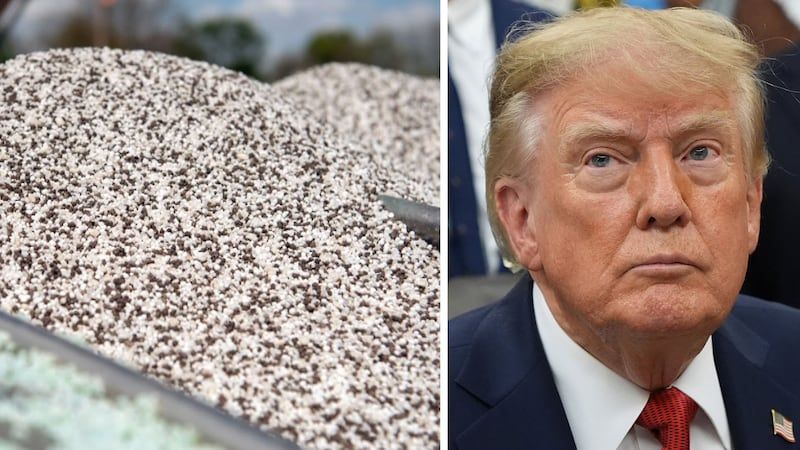
Trump's Belarus potash deal sparks outrage from Canadian leaders, industry
Saskatchewan Premier Scott Moe and other Canadian officials condemn U.S. President Donald Trump's proposed potash agreement with Belarus, citing ethical concerns over supporting Russian aggression and practical challenges in replacing Canada's $4.2 billion export industry.
Trump seeks Belarus potash to reduce U.S. reliance on Canada
U.S. President Donald Trump announced plans to negotiate a potash supply agreement with Belarus through a social media post on Monday, framing it as a cost-saving measure for American farmers. He claimed Belarusian imports would be "substantially less" expensive than Canadian supplies and called it "very good news" for U.S. agricultural producers. Potash serves as a crucial component in fertilizers used across American farms. This proposal emerges amid ongoing trade tensions between Canada and the U.S., though potash has so far remained exempt from American tariffs.
Saskatchewan premier condemns 'blood potash'
Saskatchewan Premier Scott Moe issued a forceful rebuke of Trump's proposal, labeling Belarusian potash as morally compromised due to the country's alliance with Russia during its invasion of Ukraine. "More than 40 countries, Canada and its allies, have sanctions against Belarus for supporting war criminal (Russian President Vladimir) Putin's invasion of Ukraine," Moe stated on social media. The premier framed the potential deal as indirectly funding Russian military aggression, asking "Does anyone believe Belarusian blood potash shipped through Russia is going to be more affordable, more sustainable or more ethical than potash shipped from Saskatchewan, right here in North America?" His position received support from British Columbia Premier David Eby, who characterized Trump's move as part of a pattern of targeting Canadian industries.
Logistical and economic hurdles
Multiple industry experts questioned the practical viability of Trump's proposal. Economist Erin Weir, a former Saskatchewan NDP MP, noted Belarus lacks available stockpiles for new export agreements. "Belarus is one of the major potash producers, but I don't think it has some stock of potash in reserve that President Trump is going to be able to access," Weir explained. Transportation presents another significant barrier, as Belarus became landlocked after Lithuania closed border crossings in response to its support for Russia's Ukraine invasion. Even Belarusian President Alexander Lukashenko acknowledged his country's limited capacity to fulfill such an agreement, stating in an official release that "everything is contracted" to existing buyers.
READ MORE: Canadian ministers condemn Alex Ovechkin's pro-Putin ad but remain silent on sanctions
READ MORE: Research on Chinese dyeing industry offers lessons for Canada's carbon pricing
Threat to $4.2B Canadian industry
The potential shift in U.S. sourcing poses risks to Canada's substantial potash exports, which Natural Resources Canada values at $4.2 billion annually to American markets. This represents nearly half of Canada's total potash exports. The U.S. Geological Survey reports that from 2021 to 2024, 80% of American potash imports came from Canada, with much smaller shares coming from Russia, Israel and other nations. Saskatchewan Mining Association president Pam Schwann maintained that Canadian producers operate as "price-takers" in global markets rather than price-setters, suggesting any Belarusian imports would face similar cost structures. She advised monitoring the situation without overreacting, noting global demand ensures stable markets.
Political backlash and strategic considerations
The proposal triggered widespread condemnation across Canada's political spectrum. Federal Conservative House Leader Andrew Scheer denounced Belarus as "a communist dictatorship" with a poor human rights record, calling the suggestion of replacing Canadian imports "ridiculous." Some provincial leaders advocated for stronger retaliatory measures, with Ontario Premier Doug Ford proposing Canada restrict potash and oil exports to the U.S. However, Saskatchewan's government opposes such tactics, with Moe warning export taxes would damage the provincial economy and raise fertilizer prices. The province recently implemented a 50% tax on American alcohol imports as a targeted trade response. Saskatchewan NDP Leader Carla Beck urged more decisive action from Moe to protect the province's potash industry from what she termed an "attack" by Trump.
Industry confidence amid uncertainty
Despite the political rhetoric, industry representatives expressed measured confidence in Canada's competitive advantages. Weir emphasized Saskatchewan's geographic proximity to U.S. markets allows efficient rail transport directly to agricultural regions, unlike Belarusian product that would require overseas shipping. Fertilizer Canada highlighted the reliability of integrated North American supply chains in maintaining affordability for farmers. Schwann noted the industry's strategy of diversifying beyond U.S. markets while continuing to serve American customers. Asim Biswas, an agriculture professor at the University of Guelph, cautioned that Trump's vague proposal creates market uncertainty without concrete details about implementation. Weir concluded with a touch of skepticism, suggesting Canadians view Trump's announcement with "a grain of salt, or perhaps a grain of potash," given the practical and political obstacles involved.