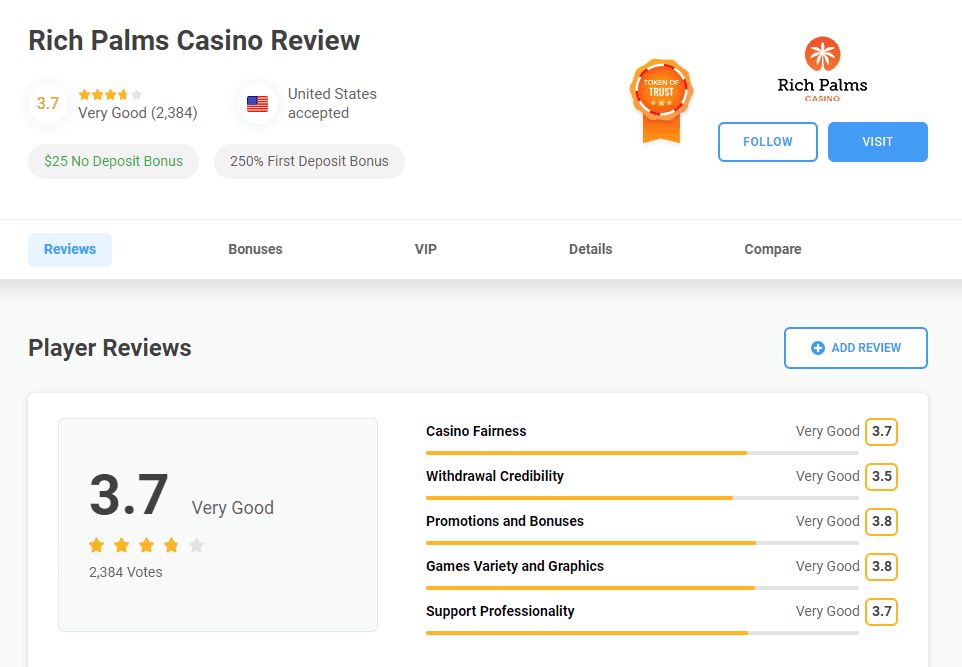
Chipy's ratings rely on a 'Token of Trust' and user-verified bonuses
Chipy is a Canadian-focused casino review site whose methodology includes a user-feedback system for verifying bonuses and operator trustworthiness.
Chipy is a website that reviews and compares online casinos and betting sites, with a declared focus on Canadian players. This review finds it a structured and community-aware platform, though its core rating methodology could be more transparent.
For a Canadian considering where to gamble online, a review site's credibility hinges on how it tests and scores operators. Chipy's approach incorporates unique user-feedback features, which are central to its value proposition and warrant close examination.
A rating system built on expert review and user feedback
Chipy states that its team of industry experts has been providing information since 2012. The site employs a multi-step evaluation process testing for game fairness, payout reliability, and customer support. Key factors in its rankings include licensing verification, software providers, mobile compatibility, and banking options. Crucially, it states that player feedback is considered to ensure ratings reflect real experiences. This feedback is formalized through two specific features. The first is the Token of Trust, a system designed to help users find the most trustworthy casinos on the website. The second is the Verified Bonus feature, which uses user feedback to confirm that advertised bonuses function as claimed. These elements suggest a move beyond purely editorial assessment towards incorporating community validation. However, the exact mechanism of the Token of Trust is not detailed in the available notes. It is unclear whether it is a simple aggregate of user ratings, a badge awarded by editors based on specific criteria, or a hybrid system. This lack of specific operational detail is a significant gap in understanding the robustness of its central trust feature.
READ MORE: Pennsylvania regulator renews Live! Casino Pittsburgh licence for five years
READ MORE: Wildz Group receives first online gambling licence for Finland's new market
Safety checks and a focus on Canadian licensing
The platform places a strong emphasis on security and regulatory compliance. For its Canadian audience, this involves verifying casinos licensed by provincial regulators like iGaming Ontario and the Alcohol and Gaming Commission of Ontario. It also prioritizes operators with valid licenses from other recognized authorities such as the Kahnawake Gaming Commission or the Malta Gaming Authority. The site claims to check for SSL encryption, responsible gambling tools, and third-party auditing for game fairness, while blacklisting casinos with unresolved complaints or predatory terms. This layered approach to safety is comprehensive on paper. The specific mention of third-party auditors like eCOGRA adds a tangible measure of game fairness verification. The practice of blacklisting operators with poor records is a strong editorial stance that benefits consumers, assuming it is applied consistently and the criteria for blacklisting are clear.
The scope and limitations of its coverage
Chipy's content is broadly tailored to casino players. It maintains updated listings of casino promotions, including welcome bonuses and no-deposit offers, with an emphasis on clear terms and conditions. It provides detailed payment guides covering methods relevant to Canadians, such as Interac, credit cards, and cryptocurrencies, comparing payout speeds and fees across operators. The site also offers game guides covering slots, live dealer tables, and progressive jackpots, with insights into RTP rates and software providers like Microgaming and Evolution Gaming. An educational section called the Academy features insights from Vegas casino specialists, veteran gamblers, and mathematicians. A noted limitation from prior assessment is its limited coverage of sports betting, and the potential for some smaller casino operators to be overlooked in its reviews. This creates a gap for users interested in a full-spectrum gambling review site, positioning Chipy more firmly as a casino specialist.
Business model and transparency considerations
Chipy is transparent about its commercial relationships, stating it highlights partnerships with casinos through an Advertiser Disclosure so users can choose with confidence. This indicates the site likely earns money through advertising or affiliate marketing, a common model in this industry. While it discloses this partnership, the notes do not specify how, or if, this financial relationship influences the scoring in its review methodology or the order of its listings. The statement that users can choose with confidence implies a separation between commercial and editorial functions, but without explicit policies detailing that separation, it remains an area where user trust is assumed rather than procedurally demonstrated. The site also promotes exclusive deals and its own raffles and Community Shop, which further integrate commercial and community activities.
Community features and responsible gambling resources
Beyond reviews, Chipy fosters a community environment with features that extend its utility beyond a static guide. It hosts raffles where users can win real money and Chipy coins, operates a Community Shop for purchasing trending items, and prominently features user reviews and ratings. The site states that responsible gambling is a priority, providing resources and links to support programs such as BeGambleAware and Gamblers Anonymous for those needing help with problem gambling. This commitment is a necessary and responsible inclusion for any platform in this sector. The community elements, like the shop and raffles, are unusual for a review site and seem aimed at increasing user engagement and time spent on the platform, which aligns with its vision of being a community-driven destination.
Usability and presentation
The site is presented in English and is described as having a clean layout. It is noted to be mobile-friendly, though no dedicated mobile application is available. Content is organized into clear sections for new casinos, bonuses, free games, and educational material, aiming to cater to both beginners and experienced players. The inclusion of a page dedicated to free casino games allows for risk-free exploration of new releases, which is a thoughtful feature for players. The overall structure supports its mission to help users make well-informed decisions by making different types of information readily accessible.
Methodological transparency and unanswered questions
The most critical area for analysis is the transparency of Chipy's core review process. While it lists evaluated factors and mentions expert testing, the notes do not detail how these factors are weighted or combined into a final score or ranking. There is no mention of a scoring rubric or a published framework that would allow a user to understand why one casino scores an 8.5 and another a 9.2. Furthermore, the interaction between the editorial team's testing and the user-driven Token of Trust and Verified Bonus systems is unclear. Are user reports the sole source for bonus verification, or does the team also test them? How are conflicting reports between users and editorial findings resolved? These are procedural questions that, if answered publicly, would significantly bolster the site's claim of fostering a trusted and transparent environment. The vision to be a go-to destination is supported by its breadth of features, but the foundation of its ratings needs clearer architectural documentation.
Verdict
Chipy presents a structured and seemingly diligent approach to reviewing online casinos for a Canadian audience. Its integration of user feedback mechanisms, like the Token of Trust and Verified Bonus, is a distinctive attempt to ground its ratings in communal experience rather than solely editorial judgment. The focus on verifying provincial licenses, providing detailed payment guides for Canadian methods, and linking to responsible gambling resources is appropriate and commendable for its target market. The additional content in the Academy and the coverage of game providers add educational value.
However, the ultimate utility and defensibility of its core rating system are somewhat obscured by a lack of methodological transparency. While it lists the factors considered and mentions expert testing, the absence of a clear, published framework for scoring and ranking limits a user's ability to fully trust the comparative outcomes. The disclosure of advertising partnerships is good practice, but without explicit detail on how commercial interests are walled off from review scores, it remains an open question for the critical user. Gambling carries financial risk, and readers must always check the laws and age limits where they live.
As a starting point for research, particularly for casino players interested in bonus verification, community insights, and Canadian-specific banking information, Chipy offers a useful and feature-rich service. It is more than a simple listicle site, evidencing effort in its multi-angle evaluations and community building. Yet, for a site whose mission is to deliver unbiased reviews and empower informed decisions, a more transparent exposition of its rating algorithm and the operational rules governing its unique trust features would transform it from a helpful tool into a genuinely authoritative standard. In its current state, it is a valuable supplemental resource rather than a definitive arbiter.