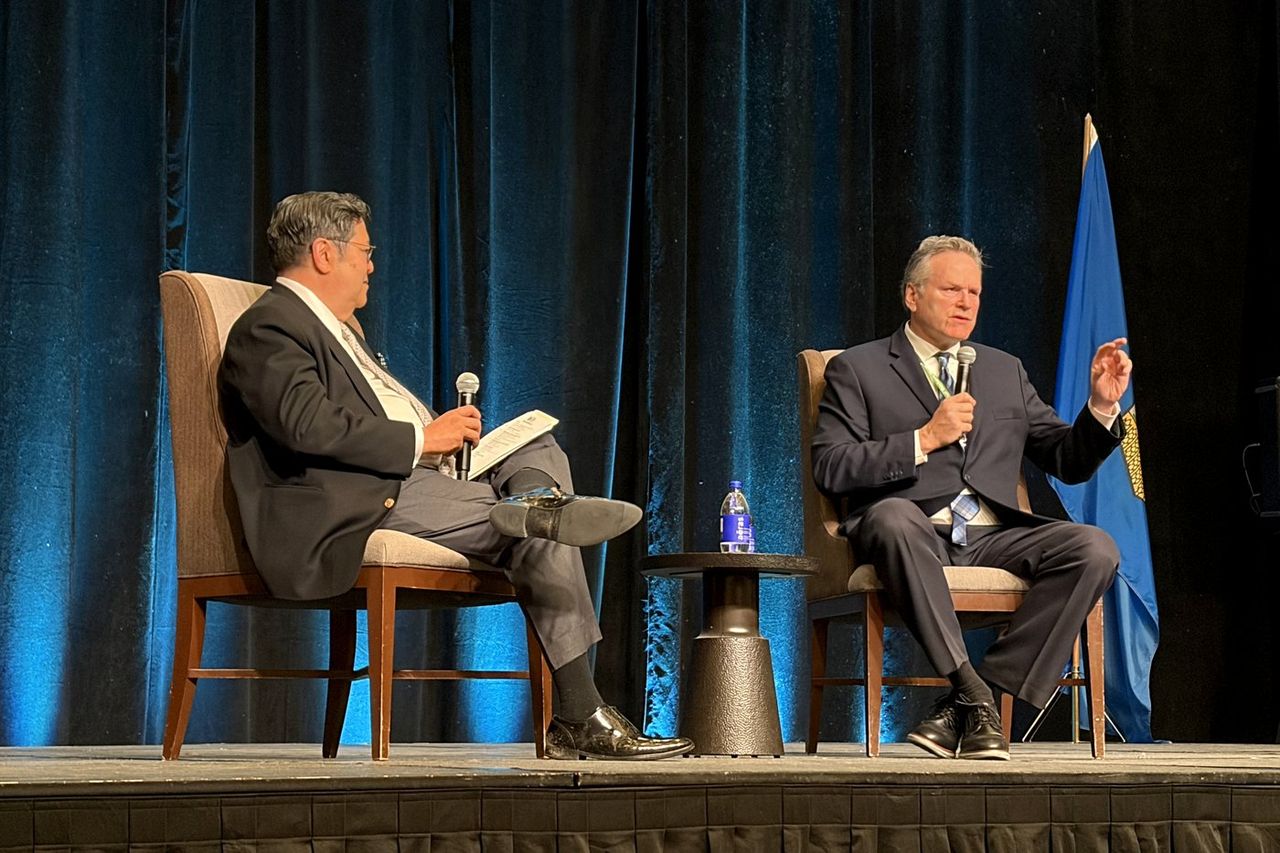
Alaska governor dismisses U.S. invasion of Canada as impossible at global forum, citing deep bilateral ties
Alaska Governor Mike Dunleavy rejected any possibility of U.S. military action against Canada during a security discussion at Alberta's Global Business Forum, calling the idea 'shocking' and emotionally hurtful to Americans while former Canadian security officials outlined more realistic defense priorities.
The governor of America's largest state by land area has forcefully dismissed speculation about a potential U.S. military invasion of Canada during an international security conference, framing the hypothetical scenario as both strategically implausible and emotionally inconceivable given the deep ties between the neighboring nations. Alaska Governor Mike Dunleavy, whose state shares the longest border with Canada at over 1,500 miles, made his remarks Friday at the Global Business Forum in Banff, Alberta, addressing recent reports that Ottawa has studied such extreme scenarios as part of routine defense planning.
Colorful rejection of invasion scenario
"I'd have a better chance of sprouting wings and flying around the audience here," Dunleavy told attendees, employing vivid imagery to underscore the absurdity of the concept. The Republican governor stated there was "zero chance" the United States would contemplate military action against its northern neighbor, adding the hyperbolic comparison that "Pennsylvania has a better chance of being invaded by West Virginia." His remarks carried particular authority given Alaska's strategic position and extensive cross-border connections with Canada.
Dunleavy's comments came days after a New York Times report revealed Prime Minister Mark Carney's government had examined a potential U.S. invasion as part of its "extreme tail risk" scenario planning. Defense Minister David McGuinty later clarified that such analysis represents standard practice for militaries worldwide, telling reporters in Ottawa that evaluating improbable threats constitutes "normal" international defense preparedness rather than indication of specific concerns about bilateral relations.
READ MORE: Canadian ministers condemn Alex Ovechkin's pro-Putin ad but remain silent on sanctions
Cultural and emotional dimensions
The Alaska governor framed the hypothetical invasion as emotionally unthinkable for ordinary Americans, suggesting such an idea would violate deeply held perceptions of Canada as family. "We see you as our brothers, siblings of the same mother," Dunleavy said, adding that the average American would find the notion "shocking" and even feel personally "hurt" by its implication. This characterization highlights how cultural affinity and shared history form powerful psychological barriers to conflict between the two nations.
Dunleavy's remarks included praise for former U.S. President Donald Trump, whom he called "the best president for the state of Alaska in our entire history," while noting Trump's repeated statements about wanting to make Canada the 51st state through economic rather than military means. The governor's comments appear to reinforce that while political rhetoric about closer integration exists, no serious military action has ever been contemplated at official levels.
Security experts analyze realistic threats
Jody Thomas, former national security and intelligence adviser to Prime Minister Justin Trudeau, concurred with Dunleavy's assessment during the same forum discussion, describing a U.S. invasion as "improbable, slightly impossible." She provided detailed insight into the extensive bilateral mechanisms that would immediately activate to prevent any military escalation between the neighbors.
"Immediately, there would be calls from the Prime Minister's Office to the White House. The diplomats, State, Global Affairs, Canada, our ambassadors, would be talking. The chief of the defence staff would be talking to the chairman of the military committee to understand what's going on and stop it," Thomas explained.
Her description revealed the multiple layers of diplomatic and military communication channels that would engage long before any armed confrontation could develop, underscoring the institutional safeguards against such scenarios.
Canada's evolving defense priorities
Thomas redirected the discussion toward more plausible security concerns, noting "we have adversaries out there and it's not something that ever has really entered the Canadian psyche." She specifically identified North Korea, China, Russia, and Middle East-based terrorist threats as more realistic priorities for Canadian defense planners. This assessment reflects Canada's gradual shift in defense posture amid renewed great power competition and global instability.
The former security adviser emphasized that economic strength forms the essential foundation of national security in the modern era. "You can't have a weak economy and be a strong country from a perspective of national security," Thomas warned, explaining how financial vulnerabilities create openings for organized crime, terrorism and foreign exploitation. Her comments suggest Canadian officials increasingly view economic resilience as integral to comprehensive national defense strategy rather than separate from military preparedness.
Integrated approach to national resilience
Thomas offered pointed criticism of Canada's historical tendency to develop defense, economic and environmental policies in isolation from each other. "We have looked at things in silos in Canada for too long," she told the forum, advocating for "systems thinking end-to-end about the implications of where we're spending money and why."
She connected military preparedness with broader national resilience, stating "if you have not invested in your armed forces, you cannot defend your country" while simultaneously noting how environmental disasters can devastate key industries and economic sectors. This holistic perspective represents a growing recognition within security circles that modern threats require coordinated responses across multiple policy domains rather than separate bureaucratic approaches.
Military realities and diplomatic solutions
Thomas provided a clear-eyed assessment of the military imbalance between the two nations, noting "The United States is 10 times larger than us" in terms of defense capabilities and resources. She suggested any hypothetical conflict would likely be brief due to Canada's pragmatic approach, stating "There'd be maybe a few days of mobilization and movement before I think it would stop because Canada would not want harm done to our citizens. We would not want to see loss of life." This pragmatic assessment underscores Canada's traditional reliance on diplomacy and alliance management over military confrontation.
Geopolitical context of scenario planning
The Banff forum discussion occurs against a backdrop of shifting global power dynamics and renewed emphasis on North American security cooperation. While the U.S.-Canada military alliance remains strong through NATO and NORAD, the very fact such invasion scenarios receive high-level consideration, even as remote possibilities, reflects how traditional alliances are being reassessed in an era of geopolitical uncertainty and changing American foreign policy orientations.
More significantly, the exchange highlights Canada's evolving defense posture as it confronts new types of threats in an increasingly multipolar world. Thomas' warnings about economic security and integrated planning suggest Canadian officials are developing more sophisticated frameworks for national resilience that extend beyond conventional military capabilities. As international tensions rise and alliance systems face new pressures, even close allies appear compelled to examine once-unthinkable scenarios, if only to confirm their implausibility and reinforce the importance of maintaining strong bilateral relationships.
Broader implications for North American security
The discussion at Banff ultimately revealed more about the strength of U.S.-Canada relations than about any genuine risk of conflict. The spontaneous rejection of invasion scenarios by both American and Canadian officials demonstrates the depth of trust and institutional connections between the two nations. However, the conversation also illuminated how defense planners must consider even extremely low-probability events in an era of global instability, while keeping such analysis in proper perspective.
Perhaps most importantly, the forum underscored how traditional military threats represent only one dimension of national security in the 21st century, with economic strength, environmental resilience, and integrated policy-making emerging as equally critical components of comprehensive defense strategies. As Canada continues to handle complex international relationships and emerging threats, this broader conception of security will likely shape its defense planning for decades to come.