Canada needs 19 million EV charging ports by 2040, institute says
A new report says the country must build millions of charging ports to support an expected 21 million electric vehicles.
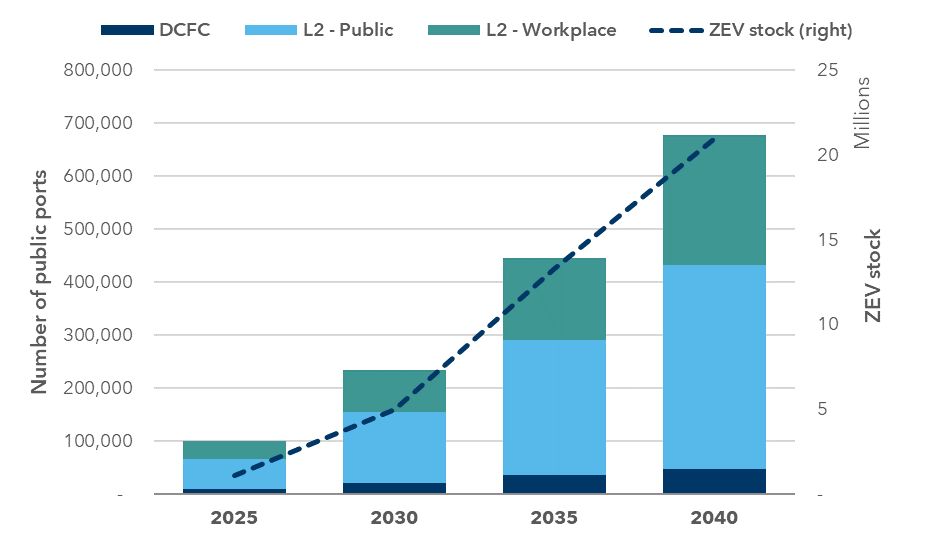
Canada will need 19 million electric vehicle charging ports by 2040 to support the roughly 21 million EVs expected on its roads by then, according to a new report. The analysis from the Canadian Climate Institute says this represents a nearly twentyfold increase from the roughly one million ports available today. The report, titled Leading the Charge, frames this buildout as an essential part of the country's path to net-zero emissions. It argues that while governments are focused on large-scale electricity projects, these millions of "small steps" are crucial for bringing the benefits of electrification to Canadians.
The vast majority of the new installations are expected to be in people's homes, which the institute calls a "good news story" because it means governments will not have to plan and build the bulk of the infrastructure. "Most new chargers will likely be easily and cheaply installed when households purchase an EV," the report states. It compares the task to installing a new washer and dryer, saying the overall goal is ambitious but most steps are readily achievable. However, the report warns that government action is still vital to overcome four main barriers that could block the buildout and slow the transition to electric vehicles. It says policy interventions are needed to provide certainty for automakers, charging providers and EV owners. "Automakers, charging providers, and Canadian EV owners alike need policy certainty to proceed with confidence in making their own investment and purchase decisions, to know that the infrastructure will be ready when they need it and customers will be there to use it," the report says.
The institute points to the federal government's recent announcement that tailpipe emissions standards will remain at 2026 levels until 2030 as a move that "compromises this certainty in the near term." It says getting Canada back on track to reach its goal of 75 per cent EV sales by 2035 and 90 per cent by 2040 will require future standards to ramp up quickly after 2030. The report also calls for direct federal support to build charging infrastructure in rural and remote communities, noting substantial gaps in Canada's fast charging network across the national highway system. It recommends that the federal government provide similar support for people living in multi-unit residential buildings. Provincial and territorial governments, which have more direct control over building codes and electricity grids, should follow Quebec's lead and update codes to require all new multi-unit buildings to be EV-ready, the report says. Provincial governments should also guide grid regulators to enable rate designs that make demand charges economically viable and maximize managed charging for Level 2 chargers.
The institute recommends an approach that tackles both supply and demand, combining broad regulatory measures, changes to electricity markets and targeted funding. It says overcoming these specific obstacles can help provide policy certainty, encouraging markets and households to move in the same direction and reducing the cost of electrifying transport. "Governments can then provide targeted funding for sectors the market can't adequately address," the report states. The federal government's charging infrastructure strategy and vehicle emissions standards are still in development, which the institute says would be welcome developments indicating the government knows the right route to net zero.
With files from Canadian Climate Institute